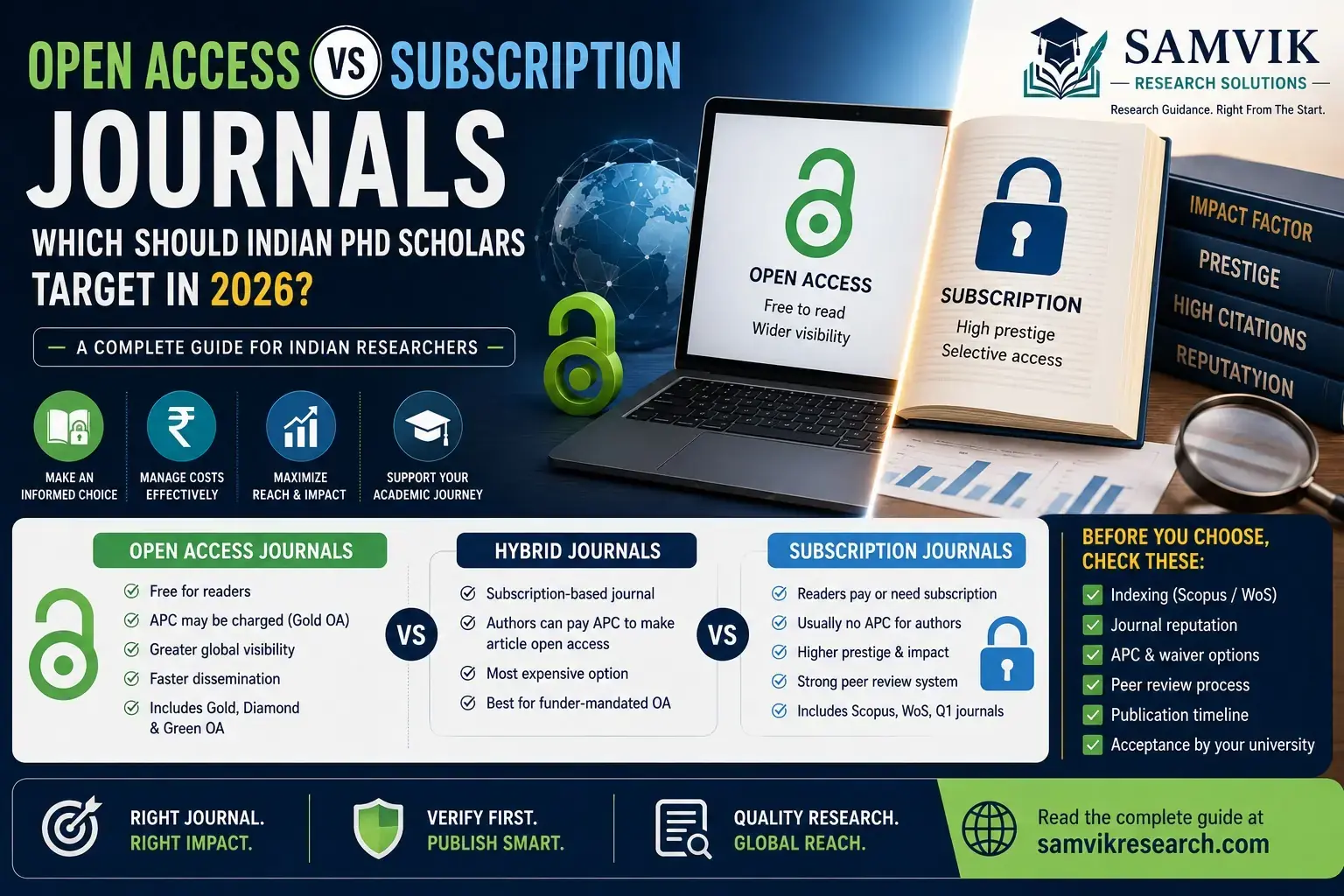

Not all journals work the same way. Some charge you to publish. Some charge readers to read. Some are completely free for everyone. Choosing the wrong type can cost you money, limit who reads your research, or leave your publication uncounted at thesis evaluation. This guide explains every major journal type in plain language — what each one costs, how often they publish, and which one fits your situation.
Quick Answer — Open Access vs Subscription vs HybridOpen Access=Reader pays nothing; author may pay an APC. Maximises global visibility. Many Scopus/WoS journals are open access. Diamond open access is entirely free.Subscription=Reader pays; author usually does not. Best for prestige and citation impact. Most WoS Q1 and SCI journals are subscription-based.Hybrid=Reader pays unless the author buys open access. Best for grant-funded researchers. Usually the most expensive APC option.What matters most=Not the publication model — genuine Scopus or WoS indexation, real peer review, and acceptance by your institution.Why Journal Type Matters for Indian PhD Scholars
Indian universities require publication before thesis submission. Fellowship committees assess your publication record. API promotion systems count publications based on where they appear. Most Indian scholars have little or no institutional APC budget.
Getting journal type wrong means your publication might not count, might not be read, or might cost money you cannot recover — especially if the journal turns out to be predatory. Twenty minutes understanding the landscape saves months of damage control.Open Access Journals Explained
An open access journal makes every published article freely available to anyone — no paywall, no subscription, no institutional login. The moment your paper publishes, any researcher, student, or policymaker anywhere in the world can read it. There are three types of open access Indian scholars need to know.
Gold Open Access
The journal is entirely free to read, funded by an Article Processing Charge (APC) paid by the author. APCs range from a few hundred to several thousand dollars depending on the publisher. Many high-quality Scopus and WoS indexed journals are gold open access. The presence of an APC does not make a journal predatory — verifiable indexation and genuine peer review determine legitimacy.
Diamond Open Access
The journal charges neither authors nor readers. Publishing is completely free. These journals are typically funded by universities or learned societies, and many high-quality Indian journals operate on this model. For scholars with no APC budget who need a legitimate indexed publication, diamond open access is a strong and often overlooked option.
Green Open Access
Green open access is not a journal type — it is a way to make your work freely available even after publishing in a subscription journal. Most publishers allow you to self-archive the accepted version of your manuscript on ResearchGate, Academia.edu, or an institutional repository. This is free and maximises reach without paying any APC. Always check the journal's self-archiving policy first.
Yes, you can publish in Scopus journals for free. Many Scopus-indexed journals are diamond open access. Others are subscription journals where you pay nothing to publish and can self-archive via green open access. Even among gold open access Scopus journals, many offer APC waivers — most scholars never ask because they assume they cannot afford it. Email the editorial office before ruling out a journal on cost grounds.Are Open Access Journals Accepted for PhD Submission in India?
Yes. For Indian PhD thesis submission requirements, what matters is whether the journal is indexed in a recognised database — Scopus, WoS, or as per your university's specific regulations — not whether it is open access or subscription. A Scopus-indexed diamond open access journal satisfies the same thesis requirement as a Scopus-indexed subscription journal.
⚠️ Always verify with your institution's current PhD regulations, particularly following the UGC CARE discontinuation in 2025. Requirements are actively changing at many Indian universities.Subscription Journals — Closed Access, Highest Prestige
A subscription journal restricts article access to paying subscribers. Most of the world's highest-impact journals operate on this model — including the majority of Scopus Q1 and WoS SCI journals.
Many high-impact subscription journals receive strong citation activity, although citation performance ultimately depends on article quality, visibility, and field rather than the subscription model alone. For fellowship applications, faculty promotions, and international research profiles, a WoS Q1 subscription journal publication carries significant weight. Green open access self-archiving is the most practical way to maximise the reach of a subscription journal article without switching journals or paying an APC.
Hybrid Journals — The Middle Ground
A hybrid journal is primarily a subscription journal that gives authors the option to pay an APC to make their specific article open access within an otherwise closed publication.
This is relevant when your funder or an ANRF grant requires open access but the most appropriate journal for your field is subscription-based. Hybrid APCs tend to be the most expensive in publishing — often USD 2,000 to USD 5,000 at major publishers. Unless a grant covers this cost, hybrid open access is rarely the most practical choice for Indian scholars.
Predatory Open Access — The Danger Zone
Not all open access is genuine. Predatory journals collect APCs while providing no real peer review and no genuine academic value. Since the UGC CARE list was discontinued in February 2025, predatory journals have been claiming to be "UGC CARE approved 2026" to target confused Indian scholars. This is impossible — the approval system no longer exists.
⚠️ Always verify at scopus.com/sources or mjl.clarivate.com before paying any APC. If the journal does not appear, do not submit. Learn the warning signs in our guide on how to identify a predatory journal.Open Access vs Subscription vs Hybrid — Compared
| Factor | Open Access | Subscription | Hybrid |
|---|---|---|---|
| Who pays to read | No one | Reader / institution | Reader, unless OA bought |
| Who pays to publish | Author (gold) / no one (diamond) | Usually no one | Author, for OA option |
| Visibility | Highest | Limited to subscribers | Mixed |
| Prestige / citations | Strong, varies | Often highest | Same as base journal |
| Typical cost | Free–several thousand USD | Free to author | USD 2,000–5,000 |
| Best for | Maximum readership | Prestige, fellowships | Grant-funded OA mandates |
Publication Frequency and Your Thesis Deadline
Continuously publishing journals post articles online within two to eight weeks of acceptance — how most major Scopus and WoS journals now operate. Monthly journals take two to four months. Quarterly journals can mean six to twelve months after acceptance.
Most Indian universities accept an official acceptance letter for thesis submission — you do not need the paper to be in print. This means review-to-acceptance speed matters more than publication frequency when selecting a journal under a deadline.Open Access vs Subscription: Which Is Better?
Neither is objectively better. Each serves a different purpose.
Open access is better when your priority is maximum readership, your research addresses a broad audience including practitioners and policymakers, or your funder requires open access publication.
Subscription journals are better when your priority is prestige, high citation impact in an established field, or building a profile for fellowship and promotion applications that weight journal reputation heavily.
How to Choose the Right Journal Type for Your Research
Choosing the right journal is not just about open access or subscription. Run through these five checks before you submit to any journal:
Verify current Scopus or WoS indexation independently at scopus.com/sources or mjl.clarivate.com — never trust the journal's own website.
Check the APC and whether waivers are available if cost is a concern.
Check the typical review-to-acceptance timeline, especially if you are working toward a thesis submission deadline.
Read the journal's Aims & Scope and three to four recent articles to confirm your research genuinely fits.
Confirm the journal is accepted by your institution under its current post-UGC CARE PhD regulations.
Frequently Asked Questions
What is the difference between open access and subscription journals?▾Open access journals make articles freely available to all readers. Subscription journals restrict access to paying subscribers. Both can be high-quality and Scopus or WoS indexed — the difference is in who pays for access.Is open access better than subscription for Indian PhD scholars?▾Neither is universally better. Open access maximises visibility. Subscription journals typically offer higher prestige and citation impact. For thesis submission in India, both are equally valid as long as the journal is genuinely indexed. Your choice should depend on your specific goal — visibility, prestige, budget, or funder requirements.Do Scopus journals always charge APCs?▾No. Many Scopus-indexed journals are subscription-based and charge no APC to authors. Among open access Scopus journals, diamond open access journals charge no APC at all. Even gold open access Scopus journals often offer APC waivers for eligible scholars.Can I publish in Scopus without paying?▾Yes. Diamond open access Scopus journals are free to publish in and free to read. Subscription Scopus journals charge nothing to authors. You can also use green open access self-archiving to share your subscription journal article for free. Ask about APC waivers at gold open access journals before assuming you cannot afford them.What are APC waivers?▾APC waivers are fee exemptions offered by open access journals to authors who cannot afford the Article Processing Charge. Many high-quality Scopus and WoS journals offer full or partial waivers for scholars from lower-income institutions or countries. They are underused because most scholars never ask. Email the editorial office directly.What is the difference between gold, green, and diamond open access?▾Gold open access means the journal is free to read, funded by author APCs. Diamond open access means the journal is free for both authors and readers. Green open access means self-archiving a version of your article from a subscription journal in a public repository — free to do and widely permitted by major publishers.Not Sure Which Journal Is Right for Your Research?
SAMVIK Research Solutions provides journal selection guidance, indexation verification, and pre-submission manuscript review specifically for Indian PhD scholars.
Talk to a SAMVIK Expert →MDr. Megha GuptaResearch Manager – Life Sciences & Journal ReviewerSAMVIK Research Solutions provides journal selection guidance and publication support for Indian PhD scholars — including indexation verification, APC and waiver guidance, and pre-submission manuscript review.Related reading: Scopus vs WoS vs UGC CARE — Which Journal Should You Target · What Is a Predatory Journal and How to Identify One · Pre-Submission Checklist for Research Papers · How to Avoid Desk Rejection · UGC CARE 2025 Discontinued