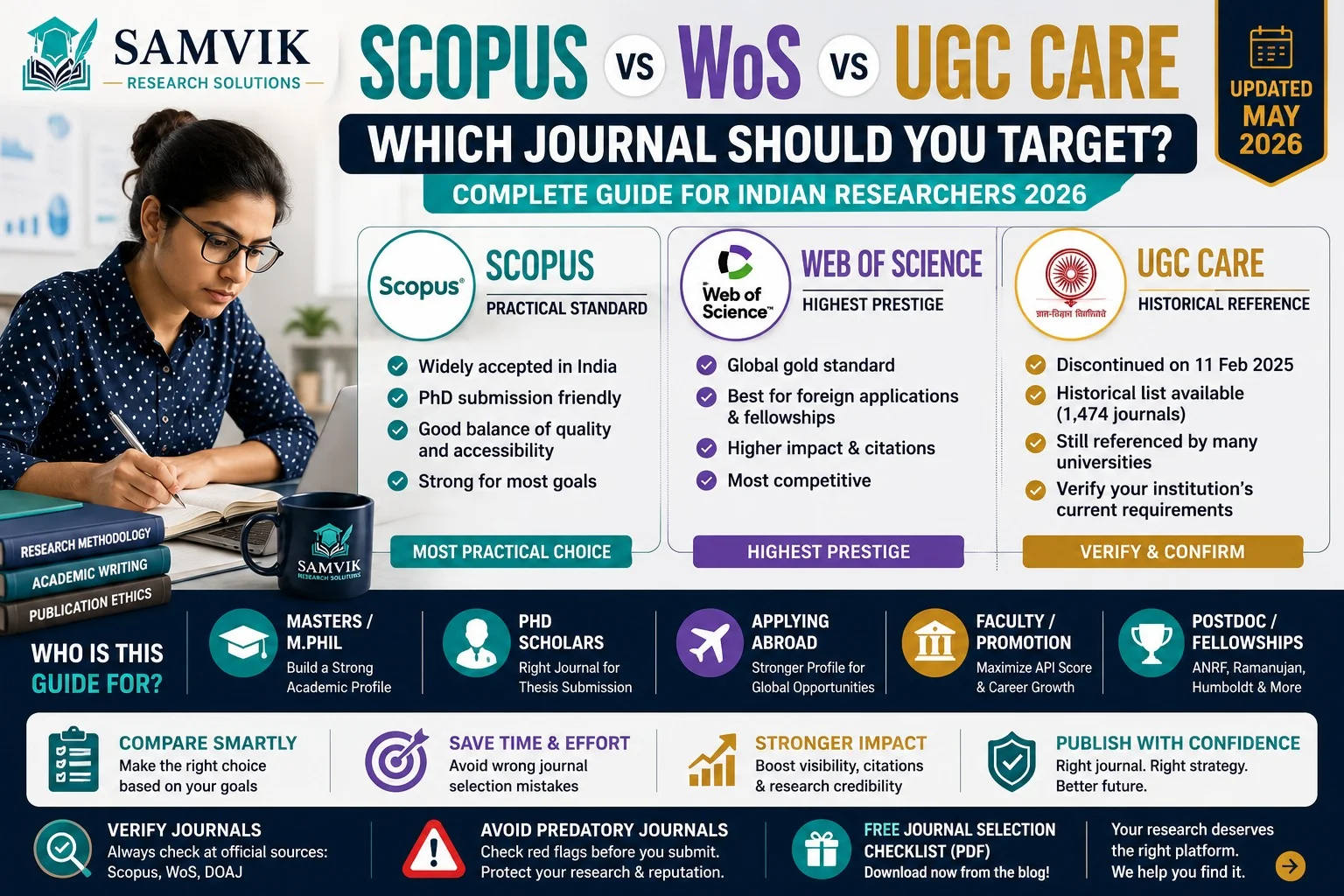
Scopus vs Web of Science vs UGC CARE: Which Journal Should You Target?
Dr. Mukul Misra
7 May 2026
18 min read
Every Indian researcher has faced this moment. Paper ready. Submit button right there. But which journal? Scopus. WoS. UGC CARE. Q1. Q2. SCI. SSCI. Indexed. Non-indexed. Peer-reviewed. The answer depends entirely on who you are and what you are trying to achieve — and getting it wrong can cost you months, money, and in some cases, your PhD submission itself.
Quick Answer — What Each Journal Type Means
Scopus
=
Best practical option for most Indian PhD scholars in 2026. Universally accepted, widest coverage, satisfies new UGC quality parameters.
WoS / SCI
=
Highest international prestige. Best for foreign applications, senior faculty promotions, and fellowship applications like ANRF and Ramanujan.
UGC CARE
=
Officially discontinued February 2025. Historical reference list of 1,474 journals still cited by some universities. Always verify with your institution.
Peer-reviewed
=
Minimum standard for legitimate academic publishing. Not sufficient for PhD or promotion without indexation. Acceptable for some Masters requirements only.
Google Scholar
=
Not a quality index. Google Scholar indexes everything automatically — including predatory journals. Being "on Google Scholar" proves nothing. Anyone can publish in any journal and have it indexed there within days.
Non-indexed
=
Avoid for PhD, promotions, or foreign applications. Carries no weight with universities, fellowship committees, or international institutions.
Predatory
=
Never publish here. Fake indexation claims, no peer review, permanent reputation damage. Many are now falsely claiming "UGC CARE approved 2026."
Scopus vs WoS vs UGC CARE — Side-by-Side
Scopus indexed journals are the safest minimum standard for most Indian PhD scholars in 2026 because they are accepted universally by Indian universities, API promotion systems, and foreign institutions — and they satisfy UGC's own new post-CARE quality parameters by definition.
✓✓ = Strongly accepted · ✓ = Accepted · ⚠ = Depends on your institution · ✗ = Not accepted
⚠️ UGC CARE Update: The UGC CARE journal list was officially discontinued on 11 February 2025. Many universities still reference it. Always verify your institution's current requirements before submitting. Full details: UGC CARE 2025 — What Replaced It
Visual Comparison: Scopus vs WoS vs UGC CARE
Which Journal Index Should You Use?
🔬
Scopus
Best for PhD India
27,000+ journals covered
Accepted by all Indian universities
Satisfies new UGC parameters
Strong for foreign applications
CiteScore + SJR metrics
Verify: scopus.com/sources
🏆
Web of Science
Highest Prestige
21,000+ journals (more selective)
Global gold standard
Best for foreign + fellowship
Highest API score in India
Impact Factor calculated here
Verify: mjl.clarivate.com
📋
UGC CARE
Discontinued 2025
1,474 journals (frozen list)
India-only recognition
Some universities still cite it
Zero weight internationally
Predatory journals fake it
Verify: ugc.gov.in only
Decision Flowchart: Which Journal Do You Need?
Answer two questions. Get your journal target.
Q1: Are you applying to a foreign university or international fellowship?
↓
YES
Target WoS / SCI / SSCI
Q1 or Q2 journals · mjl.clarivate.com
NO — Continue to Q2
Stay in India path ↓
↓
Q2: What is your academic level or goal?
↓
PhD Submission
Scopus-indexed · scopus.com/sources
Faculty Promotion
Scopus or WoS · Check API formula
Masters / M.Phil
Peer-reviewed minimum · Scopus preferred
ANRF / Ramanujan
WoS Q1/Q2 strongly preferred
Every Journal Type Explained — Click to Expand
1
Web of Science — SCI / SSCI / AHCI
Global gold standard · Highest prestige for Indian researchers
Highest PrestigeQ1/Q2
▾
Web of Science is the most selective and prestigious journal index globally. SCI covers natural sciences and engineering, SSCI covers social sciences, and AHCI covers arts and humanities. For Indian researchers, a WoS publication — especially in Q1 or Q2 — represents the highest achievement in academic publishing and carries maximum weight for foreign applications, fellowships, and senior faculty promotions.
Why target WoS
Globally recognised — accepted everywhere
Maximum weight for ANRF, Ramanujan, N-PDF fellowships
Highest API score in Indian promotion systems
Impact Factor (JIF) calculated here
Best for foreign university applications
Challenges
70–90% rejection rates at top journals
Review cycles 3–12 months typical
High language quality required
APCs can be significant for OA journals
🎯 Best for: PhD scholars targeting postdoctoral research, professors seeking promotion, researchers applying to foreign universities, and all ANRF / Ramanujan / Humboldt / Marie Curie fellowship applicants. Verify at:mjl.clarivate.com
2
Scopus Indexed Journals
The practical PhD standard for India in 2026
PhD Standard27,000+ Journals
▾
Scopus covers over 27,000 peer-reviewed journals — the world's largest abstract and citation database. For Indian PhD scholars in 2026, Scopus-indexed publication is the most practical and universally accepted benchmark. After the UGC CARE discontinuation, most progressive Indian universities have shifted to Scopus as their primary requirement. A Scopus publication also satisfies the new UGC Suggestive Parameters for journal quality by definition.
Why target Scopus
Accepted by all Indian universities for PhD
Satisfies new UGC quality parameters
Wider journal choice than WoS
Strong for foreign university applications
Many open access Scopus journals have zero APC
Things to know
Quality varies widely — Q1 ≠ Q4 in prestige
Journals can get delisted — always verify
Review cycles 2–6 months typically
Desk rejection 40–60% at competitive journals
🎯 Best for: PhD scholars (safe minimum), faculty at any career stage, researchers applying to Indian or international postdoc positions. Verify at:scopus.com/sources
3
UGC CARE Listed Journals (Historical)
Discontinued Feb 2025 — still referenced by many Indian universities
India-SpecificDiscontinued
▾
The UGC CARE list ran from 2018 to February 2025, when it was officially discontinued. A frozen reference list of 1,474 journals is available at ugc.gov.in. Many Indian universities — particularly older state and deemed universities — still reference the CARE list in their PhD regulations. This creates a critical situation: a CARE-listed but non-Scopus journal may satisfy your university's regulations today but fail updated requirements by your thesis submission date.
When CARE list matters
Your university explicitly requires it
Institution hasn't updated post-2025 PhD regs
Journal is BOTH CARE-listed AND Scopus-indexed
Key risks
Universities actively updating requirements
CARE-only journals risky for long-term career
Predatory journals falsely claim CARE status
Zero international recognition
🎯 Best strategy: If your university requires UGC CARE, target a journal that is BOTH on the historical list AND Scopus-indexed. Satisfies both requirements simultaneously. Read the full guide: UGC CARE 2025 — What Replaced It
4
Peer-Reviewed Journals (Non-Indexed) + Google Scholar
Peer-review is the minimum academic standard — but Google Scholar is NOT a quality filter
Minimum StandardMasters / Entry Level
▾
Peer-reviewed is the absolute minimum standard for any legitimate academic publication — it means your paper was evaluated by independent expert reviewers before acceptance. However, peer-reviewed alone does not mean the journal is indexed in Scopus, WoS, or any major quality database. Thousands of peer-reviewed journals exist that are not indexed anywhere reputed.
⚠️ Important — Google Scholar is NOT a journal quality index.
Google Scholar is a search engine that automatically crawls and indexes academic content from across the internet — including legitimate journals, predatory journals, grey literature, theses, conference papers, and preprints. Anyone can publish in a predatory journal and have it indexed on Google Scholar within days. Being "indexed in Google Scholar" means absolutely nothing about a journal's quality, peer review standards, or academic credibility. Do not use Google Scholar as proof that a journal is legitimate. Always verify at Scopus, WoS, DOAJ, or PubMed instead.
PhD thesis submission — most universities require indexation
Faculty API credit for promotions
Fellowship and grant applications
Foreign university profile building
Any situation where "Google Scholar indexed" is offered as proof of quality
🎯 Remember: Peer-review = minimum academic standard for legitimate publishing. Google Scholar = a search engine, not a quality index. A journal appearing on Google Scholar tells you nothing about whether it is legitimate. Always verify your institution's exact requirements and check journal quality at Scopus, WoS, or DOAJ before submitting.
✕
Predatory Journals — A Complete Red Flag Guide
Never publish here — the cost to your career is permanent
Never Use
▾
Predatory journals mimic legitimate publications to collect Article Processing Charges while providing no genuine peer review, editorial standards, or academic value. Since the UGC CARE discontinuation, predatory journals are actively targeting confused Indian scholars with false claims of "UGC CARE approved 2026" — which is impossible since the list was discontinued. India has one of the highest rates of predatory journal submissions globally, driven by publication pressure for PhD degrees and promotions.
10 red flags — avoid any journal that:
Claims "UGC CARE approved 2026" — impossible
Claims Scopus/WoS indexing — verify independently, never trust their claim
Guarantees acceptance before reviewing
Accepts within 24–72 hours
Has a Gmail, Yahoo, or Hotmail editorial address
Claims "Impact Factor" without a Clarivate listing
Sends unsolicited submission invitation emails
Has anonymous or unverifiable editorial board
Cannot be found on Scopus, WoS, DOAJ, or PubMed
Asks for APC before review is complete
Consequences of publishing in predatory journals
University refuses to count publication for PhD
API credit rejected for promotions
Fellowship applications weakened
APC money lost with no recourse
Name appears permanently linked to a low-quality journal in search results
Thesis submission delayed 6–12 months
🚫 Zero exceptions. No deadline pressure, no supervisor instruction, and no university publication requirement justifies predatory journal publication. The short-term convenience creates a permanent career liability. Always verify at official sources before paying any APC.
Best Journal for Each Academic Level in India
For PhD scholars in India in 2026, a Scopus-indexed journal is the safe minimum publication standard — accepted universally by Indian universities, API systems, and foreign institutions regardless of how each institution has updated its post-UGC CARE regulations.
🎓
Masters / M.Phil
Journal for Masters dissertation in India?
Check if your university requires any publication at all — many don't
Minimum: peer-reviewed journal if required
Recommended: Scopus-indexed — better for future PhD applications
Never choose a journal based on speed of publication alone
Min: Peer-reviewed · Recommended: Scopus
🔬
PhD Scholar
Best journal for PhD thesis submission in India?
Scopus-indexed is the safe minimum in 2026
If university still cites UGC CARE: target CARE + Scopus simultaneously
Verify your institution's exact current regulations in writing
For strong profiles: aim for WoS/SCI
Min: Scopus · Strong: WoS/SCI
✈️
Applying Abroad
Which journals matter for foreign university applications?
UGC CARE alone means nothing to foreign reviewers
Scopus-indexed is the minimum international standard
WoS Q1/Q2 is the strongest credential for foreign PhDs or postdocs
Citations matter as much as number of publications
Min: Scopus · Strong: WoS Q1/Q2
🏛️
Faculty / Promotion
Which journals count for API credit in India?
WoS indexed journals carry highest API score in most systems
Scopus-indexed widely accepted for API credit
Some universities still count historical UGC CARE for API — verify
Non-indexed peer-reviewed earns minimal or zero API credit
Min: Scopus · Highest API: WoS/SCI
🧪
Postdoc / Fellowship
Best journals for ANRF, Ramanujan, N-PDF applications?
WoS publications with citation counts carry most weight
Scopus accepted but WoS preferred by fellowship reviewers
Impact Factor and citations matter more than raw publication count
Q1 journal publications create the strongest fellowship applications
Min: Scopus · Best: WoS Q1 with citations
Not sure which journal fits your specific situation?
SAMVIK's research team helps Indian scholars select the right journal, prepare manuscripts, and avoid desk rejection.
Common Journal Selection Mistakes Indian Researchers Make
The most common journal selection mistake among Indian PhD scholars is choosing a journal based purely on its impact factor or rapid acceptance promise, without verifying whether it is currently indexed in Scopus or WoS — or whether it fits the research's scope.
1
Choosing journal only by fast publication speed
Journals promising publication in 2–4 weeks are almost always predatory. Legitimate indexed journals have 2–6 month review cycles minimum. Speed is a red flag, not a benefit.
2
Using the outdated UGC CARE list as an active guide
The UGC CARE list was discontinued in February 2025. Third-party websites still displaying it as "current" are showing historical data. Only ugc.gov.in is the official source — and it explicitly states the list is no longer endorsed.
3
Ignoring journal scope — targeting impact factor only
Scope mismatch is the leading cause of desk rejection. A high-IF journal in the wrong discipline will reject your paper in under 15 minutes. Read the journal's recent papers before submitting.
4
Trusting journal websites for indexation claims
Always verify independently. Journals claiming "Scopus indexed" or "WoS listed" on their own website may be outdated or lying entirely. Check scopus.com/sources and mjl.clarivate.com directly.
5
Not checking if your university has updated its requirements
After the UGC CARE discontinuation, university requirements are actively changing. A journal accepted by your institution in 2023 may not be accepted in 2026. Verify with your research cell before submitting — in writing.
How to Verify If a Journal Is Indexed — Step by Step
To verify if a journal is Scopus indexed, go to scopus.com/sources and search by journal title or ISSN. If the journal appears with active status, it is currently indexed. Never trust a journal's own website claim — always verify at the official source.
1
Find the journal's ISSN number
Every legitimate journal has a registered ISSN (International Standard Serial Number). You can find it on the journal's About page. If no ISSN is listed or it cannot be verified, that alone is a serious red flag.
Go to scopus.com/sources and search by journal name or ISSN. Check that the status shows as "Active" — not "Discontinued" or "Temporarily Not Available." If the journal does not appear, it is not Scopus indexed, regardless of what its website claims.
Check Clarivate / Web of Science Master Journal List
Go to mjl.clarivate.com and search by journal title or ISSN. You can filter by SCI, SSCI, AHCI, and Emerging Sources CI. Journals appear here only if they have passed Clarivate's rigorous selection criteria.
The Directory of Open Access Journals (DOAJ) vets open access journals for minimum quality standards. If a journal claims to be legitimate and open access but is not listed on DOAJ, treat it as potentially predatory.
Google the journal name + "predatory" or + "beall's list"
Researchers report predatory journals publicly. A quick search of the journal name alongside "predatory," "scam," or "fake" will surface complaints from researchers who have been deceived. This is not a substitute for database verification, but it is a useful final check.
Best Publication Strategy for Indian PhD Scholars in 2026
The safest publication strategy for an Indian PhD scholar in 2026 is to target a journal that is simultaneously Scopus-indexed and appears on the historical UGC CARE reference list. This covers all institutional requirements regardless of whether your university has updated its regulations after the CARE discontinuation.
Start with your institution's requirements — not the journal. Email your research cell and ask explicitly: "What journals are currently accepted for PhD publication requirements?" Get that answer in writing. Once you know the minimum, work upward: Scopus if your university requires indexation, WoS if you are building a profile for fellowship or foreign applications.
For each journal you consider, verify current indexation independently at the official database sources — not on the journal's website. Read 3–4 recent papers from the journal before committing to submission. Does your research extend the conversation that journal is having? If yes, you have found a candidate worth pursuing. If not, move on regardless of the impact factor.
Before you submit to any journal, run through SAMVIK's pre-submission checklist — 16 things to verify including journal scope alignment, abstract quality, plagiarism check, and cover letter. It takes 20 minutes and catches what editors catch in 15. And if your paper is getting desk-rejected repeatedly, our detailed guide on how to avoid desk rejection covers all 10 causes and their fixes.
The safest single rule for 2026: If a journal is not findable on scopus.com/sources, mjl.clarivate.com, doaj.org, or ncbi.nlm.nih.gov/nlmcatalog — do not submit to it and do not pay any APC. Official database information is always free.
📥 Free Journal Selection Checklist PDF
Download SAMVIK's free journal selection checklist — 12 questions to verify before you submit to any journal. Used by PhD scholars across India targeting Scopus and WoS journals.
✓ Check your inbox — checklist is on its way!
🔒 No spam. PDF delivered instantly. Unsubscribe anytime.
Frequently Asked Questions
Is a journal indexed on Google Scholar good enough for a PhD in India?▾
No. Google Scholar is a search engine — not a quality index. It automatically crawls and indexes content from across the internet, including legitimate journals, predatory journals, preprints, theses, and grey literature. Anyone can publish in any journal, including predatory ones, and have it appear on Google Scholar within days. Being "indexed on Google Scholar" means absolutely nothing about a journal's quality or academic credibility. For PhD thesis submission, you need Scopus-indexed or WoS-indexed journals — not Google Scholar indexation.
What is the minimum journal standard for PhD submission in India?▾
The minimum standard for legitimate academic publishing is peer review — meaning your paper was evaluated by independent expert reviewers before acceptance. However, peer review alone is not sufficient for most Indian PhD thesis requirements. Most universities now require Scopus-indexed or WoS-indexed journals. Peer-reviewed but non-indexed journals are generally acceptable only for Masters-level dissertations at some universities — not for PhD submissions. Always verify your specific university's current requirements.
Is Scopus better than UGC CARE for Indian PhD scholars?▾
Yes. Scopus-indexed journals are accepted universally — by Indian universities, API promotion systems, foreign institutions, and fellowship committees. UGC CARE was discontinued on 11 February 2025 and the list is now historical reference only. A Scopus-indexed journal satisfies both modern UGC quality parameters and most institutional requirements simultaneously, while UGC CARE alone has no international recognition.
Is WoS better than Scopus for Indian researchers?▾
Web of Science carries higher international prestige than Scopus due to stricter inclusion criteria. For Indian researchers applying to foreign universities, international fellowships like ANRF or Ramanujan, or seeking professor-level promotions, WoS-indexed publications (SCI/SSCI) are stronger credentials. For PhD thesis submission in India, Scopus is the more practical and accessible standard — there are more journals to choose from, and it is universally accepted by Indian institutions.
Does UGC CARE still exist in 2026?▾
The UGC CARE journal list as an active endorsed system no longer exists. It was officially discontinued on 11 February 2025. UGC replaced it with Suggestive Parameters for Peer-Reviewed Journals. A frozen historical reference list of 1,474 journals is available at ugc.gov.in but UGC has explicitly stated that inclusion no longer implies its validation or endorsement. Many Indian universities still reference the historical list in their PhD regulations — always verify your institution's current position.
Which journal is best for PhD publication in India in 2026?▾
Scopus-indexed journals are the safest and most widely accepted standard for PhD thesis submission in India in 2026. They satisfy the new UGC quality parameters and are accepted by virtually all Indian universities regardless of how each institution has updated its post-CARE policy. For a strong PhD profile — especially if you plan to apply for postdoctoral positions or fellowships — target WoS-indexed (SCI/SSCI) journals. Never publish in non-indexed or unverified journals for your PhD.
How do I verify if a journal is Scopus indexed?▾
Go to scopus.com/sources and search by journal title or ISSN. If the journal appears with "Active" status, it is currently Scopus indexed. Never trust a journal's own website when it claims Scopus indexation — journals can get delisted and predatory journals lie about indexation regularly. Always verify directly at the official Scopus source list at the time of submission, not when you started writing.
Can predatory journals claim to be Scopus or UGC CARE approved?▾
Yes — and they do so frequently. Since the UGC CARE discontinuation in 2025, dozens of journals are claiming to be "UGC CARE approved 2026," which is impossible since no approval process exists. Always verify independently at official sources: Scopus at scopus.com/sources, WoS at mjl.clarivate.com, DOAJ at doaj.org, and ISSN at portal.issn.org. The official information is always free — never pay a third party to verify journal status.
What Are Q1, Q2, Q3, and Q4 Journals? Explained Simply
Q1, Q2, Q3, and Q4 are journal quartile rankings assigned by Scopus (CiteScore) and Clarivate/WoS (JCR Impact Factor) within each subject category. Q1 is the top 25% of journals in a field, Q2 is the next 25%, and so on. For Indian PhD scholars and fellowship applicants, Q1 and Q2 publications carry the most weight.
Q1
Top 25% in subject category
Highest impact, most competitive. Strongest for fellowships, promotions, and foreign applications. Example: Computers in Human Behavior (Scopus), Nature Communications (WoS)
Q2
Top 26–50% in subject category
Good quality, widely respected. Achievable target for most Indian PhD scholars. Accepted for all promotions and fellowship applications. Example: Journal of Business Research (Scopus)
Q3
Top 51–75% in subject category
Acceptable for PhD submission in India. Less competitive, better acceptance rates. Satisfies university indexation requirements but carries less weight for senior promotions.
Q4
Bottom 25% in subject category
Still Scopus or WoS indexed, so technically acceptable for PhD. But low impact and rarely cited. Not recommended if a higher quartile is achievable. Verify it is genuinely indexed before submitting.
Note: A journal's quartile can differ between Scopus and WoS, and can also vary by subject category — a journal may be Q1 in one category and Q3 in another. Always check the quartile for your specific research category, not just the overall journal ranking.
SCI vs SCIE vs ESCI — What Is the Difference?
SCI (Science Citation Index) is the original, most prestigious WoS list for core sciences. SCIE (SCI Expanded) covers a broader range of science journals. ESCI (Emerging Sources Citation Index) is the entry-level WoS list for journals still establishing their impact. For Indian researchers, SCIE journals are the practical WoS target.
SCI
Science Citation Index
Original core science list. ~3,700 journals in natural sciences and engineering. Highest prestige within WoS. Also included in SCIE.
SCIE
SCI Expanded ✓ Recommended
Broader science coverage including SCI + additional journals. ~9,200 journals. The practical WoS target for Indian scientists and engineers. Fully accepted for promotions and fellowships.
ESCI
Emerging Sources CI
Entry-level WoS index. ~7,000 journals still establishing impact metrics. Does NOT have Impact Factor yet. Accepted by some Indian universities for PhD — verify with your institution before submitting.
Social sciences and humanities: SSCI (Social Sciences Citation Index) and AHCI (Arts & Humanities Citation Index) are the equivalent WoS lists for non-science disciplines. Verify at mjl.clarivate.com
Can a Scopus Indexed Journal Get Discontinued?
Yes — Scopus journals can and do get delisted. Elsevier periodically reviews journals in the Scopus database and removes those that no longer meet quality criteria. This means a journal that was Scopus-indexed when you submitted may not be indexed when your paper is published — or when your university evaluates your thesis. Always verify at scopus.com/sources at the time of submission.
Several journals with significant Indian researcher communities have been delisted from Scopus in recent years after failing re-evaluation. If you published in a journal that has since been removed from Scopus, whether your publication still counts depends entirely on your institution's policy — some accept the date of publication as the reference point, others require current indexation at the time of thesis evaluation.
Protect yourself: Check the journal's Scopus status at the time you submit AND screenshot/save the Scopus source page showing active status on that date. This documentation can be important if a journal is later delisted before your thesis evaluation.
How Many Research Papers Are Required for a PhD in India?
Most Indian universities require 1 to 2 published or accepted research papers in peer-reviewed journals for PhD thesis submission. The exact number, and the journal type required, varies significantly between universities and is governed by each institution's PhD regulations under UGC guidelines.
UGC's minimum guidelines suggest at least one publication in a peer-reviewed journal for PhD submission eligibility. However, individual universities typically set stricter requirements. IITs and IIMs generally expect 2–3 publications in indexed journals. Central universities commonly require 1–2 Scopus or WoS publications. State universities vary widely — some still accept UGC CARE listed journals while others have updated to Scopus.
Typical PhD publication requirements by institution type
Central Universities1–2 publications · Scopus or WoS indexed generally required
State Universities1 publication minimum · Scopus or UGC CARE (check current regulations)
Deemed UniversitiesVaries widely · Verify directly with research cell
Important: UGC minimum guidelines are a floor, not a ceiling. Your institution's PhD regulations override UGC minimums. Always get your specific requirements in writing from your research cell before submitting to any journal.
Sources & References
UGC public notice on discontinuation of CARE list, February 2025] ugc.gov.in
Final reference list of UGC CARE journals (1,474 journals, frozen Feb 2025)] ugc.gov.in/e-book
Directory of Open Access Journals verification] doaj.org
International Standard Serial Number verification] portal.issn.org
S
SAMVIK Research Team
Research Writing Guidance · Meerut, Uttar Pradesh, India
SAMVIK Research Solutions has reviewed hundreds of manuscripts and guided Indian PhD scholars through journal selection across disciplines — sciences, social sciences, engineering, management, and humanities. We work specifically within the Indian academic context including UGC regulations, Shodhganga, NAAC, and the post-UGC CARE publication landscape.
PhD Manuscript ReviewJournal SelectionNAAC DocumentationResearch Writing India
Not Sure Which Journal Is Right for Your Paper?
SAMVIK's research team helps Indian scholars select the right journal, verify indexation, prepare manuscripts, and avoid desk rejection. Used by PhD scholars across India submitting to Scopus, WoS, and Q1 journals.