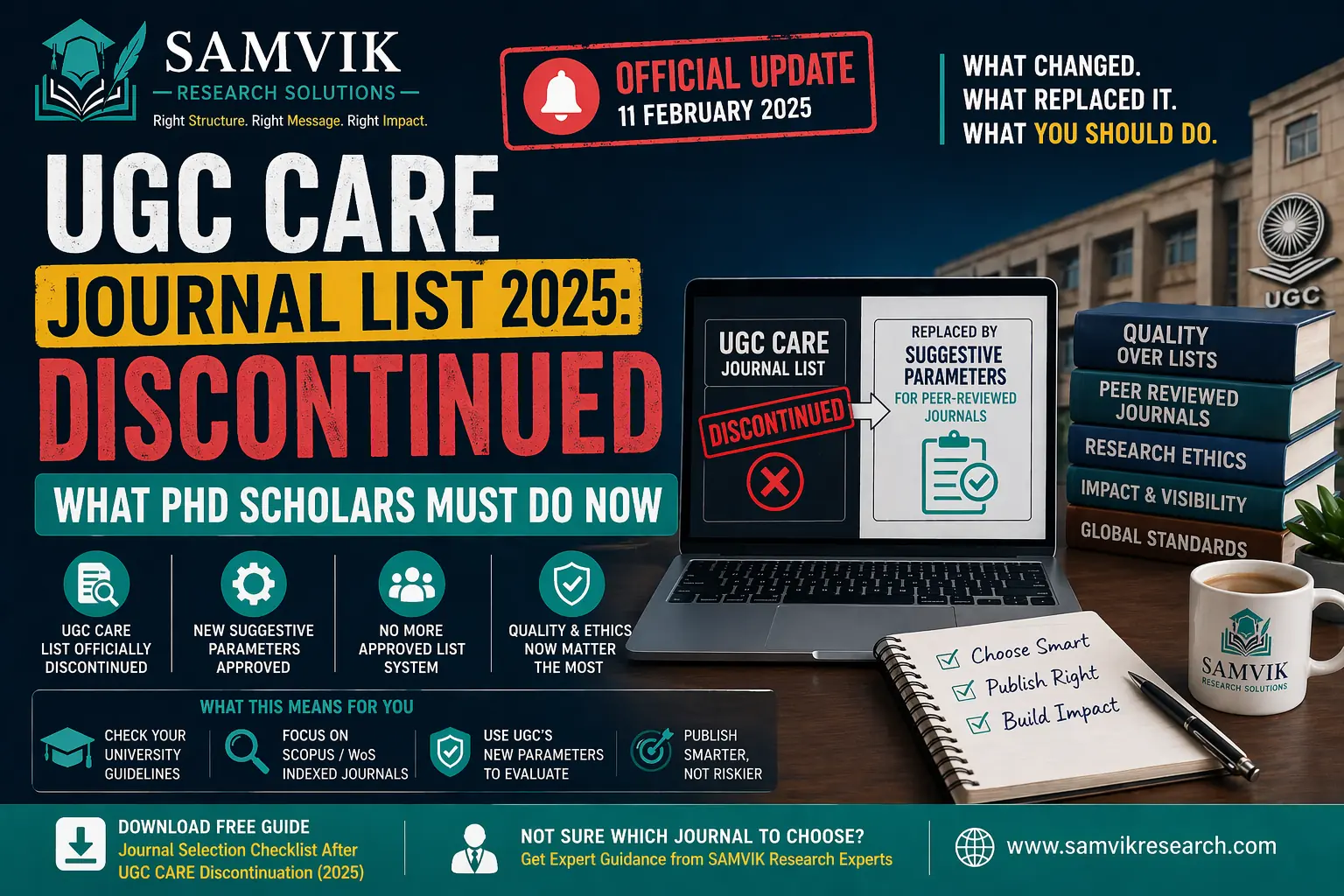

If you've been searching for the UGC CARE journal list for 2025 or 2026, here is the direct answer: the mandatory approved journal list no longer exists. UGC has moved away from maintaining a centralised list and has published quality parameters instead — expecting researchers, supervisors, and institutions to assess journals independently.
This is the biggest change in Indian academic publishing policy in years. And the confusion it is creating is real. Some websites are still showing the old list as "active." Some journals are claiming to be "UGC CARE approved" despite the discontinuation. And many PhD scholars mid-thesis genuinely don't know where they stand.
This guide cuts through all of it — with what actually happened, what the new UGC journal selection rules say, and the exact steps to protect your publications going forward. Before choosing your next journal, also review the pre-submission checklist and the IMRAD structure guide to ensure your manuscript is ready regardless of which journal you target.
What Happens If You Choose the Wrong Journal Now?
This is not theoretical. Since the discontinuation, researchers across India are facing these consequences for picking the wrong journal — often without realising it until it's too late.
Thesis submission rejected — Many universities still require publications in "UGC-accepted" journals. If you publish in a journal your university no longer considers valid, your thesis may be rejected at evaluation, causing delays of 6–12 months or more.
Money lost to predatory journals — The confusion has given predatory outlets an opening. They are actively claiming to be "UGC approved" or "CARE listed." Researchers paying APCs to these journals lose money and get publications no institution will count.
API credit not counted — Faculty members relying on publications for API appraisal or promotion face the risk of their publications being invalidated by their institution's appraisal committee if the journal doesn't meet updated criteria.
12+ months of delay — A publication your university doesn't accept means starting over — new journal, new submission, new review cycle. Every wrong choice can add a full year to your PhD or appraisal timeline.
UGC CARE List — Full Timeline of What Happened
| Date | Event |
|---|---|
| 2018 | UGC CARE launched. UGC established the Consortium for Academic and Research Ethics (CARE) to maintain a list of quality peer-reviewed journals and prevent publications in predatory outlets. Became the standard reference for PhD submissions and faculty promotions across India. |
| 2021 | List restructured to Group I and Group II. UGC reorganised the list from four groups (A, B, C, D) to two. Group I contained journals qualified through UGC-CARE protocols; Group II contained journals indexed in globally recognised databases. The list at this point covered 1,456+ journals. |
| 11 February 2025 | UGC issues official notice to discontinue. Public notice announcing discontinuation of the UGC-CARE journal listing system and the development of new suggestive parameters. This is the moment the list became inactive. |
| 24 June 2025 | New Suggestive Parameters approved. In the 595th meeting, the Commission approved the Suggestive Parameters for Peer-Reviewed Journals across 8 quality categories, as the official replacement for the CARE list. |
| 16 July 2025 | Historical reference list published — for reference only. UGC uploaded the final list of 1,474 journals (as of 10 February 2025) to ugc.gov.in. UGC explicitly clarified: inclusion on this list no longer implies validation or endorsement by the Commission. |
Is UGC CARE Still Valid in 2025? What It Means for Your Situation
The short answer: the UGC CARE list as a mandatory requirement is no longer valid. But what this means practically depends entirely on where you are in your academic journey. Here is a situation-by-situation breakdown:
| Your Situation | What It Means for You |
|---|---|
| PhD scholar who needs a publication for thesis submission | Check your university's current PhD regulations first. Many universities haven't updated their rules and still reference UGC CARE. Scopus-indexed journals are the safest choice — universally accepted regardless of how your university interprets the policy shift. |
| Faculty member needing publications for API / promotion | Your university's appraisal committee may still use the historical reference list. Check with your HoD or research cell directly. If uncertain, target Scopus or WoS indexed journals — they will be accepted by every institution. |
| About to submit to a journal from the historical CARE list | Publications in journals on the reference list may still be accepted by many universities — but verify your institution's current stance first. UGC has explicitly stated the list no longer implies endorsement, so institutional policies now vary significantly. |
| Choosing a new journal from scratch in 2025 | Use the new UGC Suggestive Parameters alongside Scopus or WoS indexation. This is the safest and most future-proof approach. Need help assessing a specific journal? Our team can guide you. |
UGC Journal Selection Rules India 2025: The New Suggestive Parameters
The UGC has replaced the mandatory journal list with Suggestive Parameters for Peer-Reviewed Journals — a framework of quality criteria across 8 categories approved in June 2025. These are not a new approved list. They are guidelines that enable researchers and institutions to evaluate journal quality themselves.
Category 1 — Journal Preliminaries
Valid ISSN number (print and/or online)
Regular, consistent publication schedule
Clear publisher contact details
Transparent peer review policy stated
Website on a certified domain
Category 2 — Editorial Board
Named members with affiliations and expertise
Subject experts — eminent researchers
Rigorous peer review process
Clear timelines for editorial decisions
Category 3 — Editorial Policy
Clearly defined aims and scope
Transparent Article Processing Charges
Published average submission-to-publication time
Stated acceptance rate
Categories 4 & 5 — Content Quality & Standards
Articles demonstrate academic contribution
Conformity to stated journal scope
Standardised referencing and bibliographic data
Professional layout and readability
Category 6 — Research Ethics
Clear ethical guidelines for authors
Plagiarism prevention policy
Conflict of interest disclosure requirement
Explicit AI-generated content policy
Categories 7 & 8 — Visibility & Impact
Indexation in reputed databases (Scopus, WoS)
Impact factor or equivalent metric
Self-citation score within acceptable range
Total citation rate vs peer journals
How to Choose Journals Safely in 2025: Step-by-Step
Check your institution's current position first. Before selecting a journal, verify what your specific university or research committee currently accepts. Email your research cell or PhD coordinator directly: "What journals are currently accepted for PhD publication requirements under the post-UGC CARE policy?" Get the answer in writing.
Target Scopus or Web of Science indexed journals as your primary benchmark. A Scopus-indexed journal will be accepted by every institution regardless of how their CARE policy is interpreted. Check at scopus.com/sources or mjl.clarivate.com.
Run the UGC Suggestive Parameters checklist. For journals not indexed in Scopus or WoS, check all 8 parameter categories above. Missing ISSN, anonymous editorial board, no ethics policy, or vague APCs are all red flags for predatory journals exploiting the post-CARE confusion.
Cross-check the historical reference list if needed. The final reference list of 1,474 journals is available at ugc.gov.in. If your university still references this list, use it to confirm whether your target journal appeared on it before discontinuation. But remember: it is a reference tool, not an endorsement.
Avoid predatory journals exploiting the confusion. If a journal aggressively solicits submissions by email, promises rapid acceptance, charges high APCs without a transparent process, or claims to be "UGC CARE approved 2026" — treat it as predatory.
Scopus, Web of Science, and Trusted Alternatives
| Database | Best For | How to Verify |
|---|---|---|
| Scopus | Science, medicine, engineering, social sciences — broadest coverage for Indian researchers | scopus.com/sources — search by journal title or ISSN |
| Web of Science | High-impact journals across all disciplines — SCI, SSCI, AHCI lists | mjl.clarivate.com — search by journal title |
| PubMed / MEDLINE | Medicine, nursing, public health, biological sciences | ncbi.nlm.nih.gov/nlmcatalog |
| DOAJ | Verifying open access journals meet quality standards | doaj.org — search by journal title |
| UGC Reference List (historical) | Checking if a journal appeared on the list before discontinuation | ugc.gov.in/e-book/Final_list_of_UGC-CAREjournals.pdf |
Related Reading
IMRAD Format Explained — The Exact Structure Journals Expect
Pre-Submission Checklist — 20 Things to Check Before You Submit
Frequently Asked Questions
Has the UGC CARE journal list been discontinued?
Yes — officially discontinued through a public notice dated 11 February 2025. The Commission's 595th meeting on 24 June 2025 approved new Suggestive Parameters as the replacement. A historical reference list of 1,474 journals is available at ugc.gov.in but inclusion no longer implies UGC validation or endorsement.
Is UGC CARE still valid in 2025?
The UGC CARE list as a mandatory approved journal list is no longer valid as of February 2025. However, many universities have not yet updated their PhD regulations. Some institutions still reference the historical list for publication requirements. Always check your specific university's current position with your research cell before submitting to any journal.
What are the new UGC journal selection rules India 2025?
As of June 2025, UGC has replaced the CARE list with Suggestive Parameters covering 8 quality categories: journal preliminaries, editorial board, editorial policy, content quality, journal standards, research ethics, visibility, and impact. Scopus and Web of Science indexation are explicitly recommended as quality benchmarks under the new parameters. HEIs are encouraged to set their own internal committees using these guidelines.
What happens if I publish in the wrong journal after UGC CARE discontinuation?
Publishing in a journal not accepted by your university can cause: thesis submission rejection, delays of 6–12 months or more, API credit not counted for faculty promotion, and financial loss if the journal charged fees. In worst cases, publishing in a predatory journal can damage your academic reputation permanently. Always verify journal acceptability with your institution before submitting.
Where can I find the old UGC CARE journal list?
The final reference list of 1,474 journals (as of 10 February 2025) is available at ugc.gov.in. Do not use third-party websites that charge fees or claim to show an "updated UGC CARE list 2026" — no such updated list exists. The official information is always free at ugc.gov.in.
Need help navigating the post-UGC CARE landscape?SAMVIK Research Solutions helps PhD scholars and faculty across India select the right journals, verify acceptability with their institution, and avoid predatory outlets. Talk to our publication support team or browse our research paper publication service.