Picture this: a scholar spends four, sometimes five years buried in data collection, fieldwork, and endless revisions. The thesis is finally ready. And then the similarity report comes back higher than expected — not because anything was copied deliberately, but because a chunk of the literature review leaned a little too heavily on an AI writing tool for "help with phrasing."
That scenario is playing out in research departments across the country right now. AI has quietly become part of how scholars write — used for grammar checks, structuring arguments, summarizing papers, even debugging code for data analysis. Universities know it. Publishers know it. And the University Grants Commission (UGC) has been recalibrating its stance on plagiarism and AI-assisted writing in response.
Why Is UGC Revisiting Plagiarism and AI Rules Now?
Generative AI didn't ease into academic writing gradually — it arrived all at once. ChatGPT, Gemini, and Grammarly's AI features are now standard tools on most scholars' laptops, right alongside reference managers and statistical software.
That shift brings real productivity gains. It also brings a set of problems academic institutions are still catching up to:
- AI-generated text quietly replacing a scholar's own analysis and argument
- Machine-written content used without any disclosure
- A rising risk of unintentional plagiarism, since AI tools often draw on existing published material
- Less transparency about who — or what — actually produced a section of the thesis
- Growing difficulty for supervisors and evaluators to judge what's genuinely original
What's Actually Changed in 2026
Based on recent reporting, here's a snapshot of where the framework has shifted:
| Area | What Changed |
|---|---|
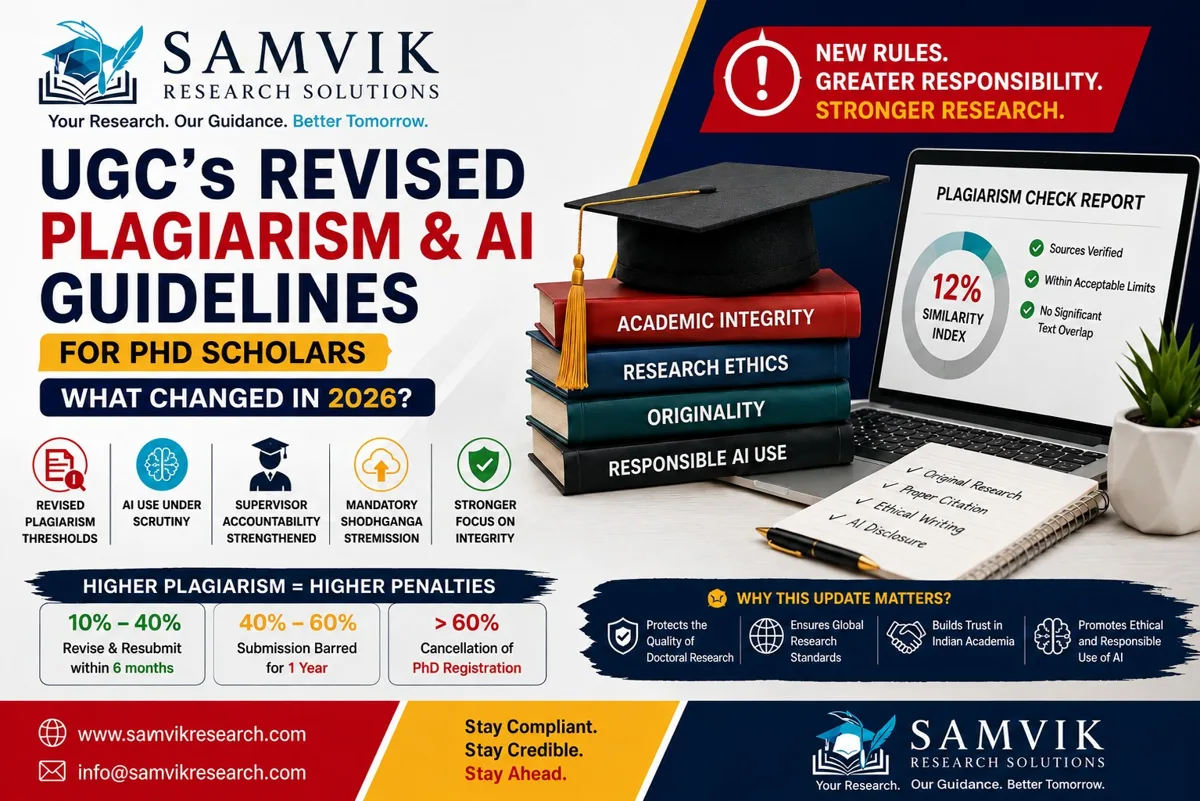
| Plagiarism penalties | Penalties now scale more clearly with the similarity percentage, rather than applying a single blanket rule |
| AI-generated content | Greater scrutiny of AI-assisted writing, particularly in core chapters |
| Supervisor accountability | Supervisors can face consequences for repeated oversight failures |
| Thesis submission | Shodhganga submission remains mandatory before degree processing |
| Academic integrity | Institutions carry more direct responsibility for verifying originality |
None of this replaces the underlying logic that's guided Indian doctoral research for years: your thesis has to be your own intellectual contribution. What's changed is how seriously — and how specifically — that gets enforced.
The Updated Plagiarism Thresholds
The similarity-percentage framework that scholars have worked with for years is still the backbone of the system. What's shifted is how strictly each band is applied.
| Similarity Band | What It Typically Means |
|---|---|
| 10% – 40% | A revise-and-resubmit cycle within a set window before evaluation can move forward. Frustrating, but recoverable — most scholars in this band fix the issue and move on. |
| 40% – 60% | This is where things get serious. Reported changes point to delayed submission timelines and closer institutional review before a thesis can proceed. |
| Above 60% | The most severe outcome — potential cancellation of PhD registration — remains on the table, subject to your institution's own procedures and the applicable regulations. |
Does UGC Ban AI Tools Outright?
No. And this is probably the single most misunderstood part of the whole conversation.
There's no blanket prohibition on using AI in doctoral research. What the framework actually asks for is:
- Original thinking behind the arguments and conclusions
- Honest authorship — no hiding who (or what) wrote a section
- Transparency about how AI was used, where relevant
- Proper attribution when it applies
- Academic integrity as the baseline, not the exception
There's a real difference between asking an AI tool to tighten your grammar and asking it to write your discussion chapter for you. One is assistance. The other is outsourcing your scholarship.
Where the Line Actually Sits
| Responsible AI Use | Unacceptable Practice |
|---|---|
| Grammar and clarity improvements | Copying AI-generated chapters without review |
| Language polishing | Fabricating references |
| Coding or data-analysis assistance | Inventing research findings |
| Brainstorming structure or ideas | Submitting AI-written literature reviews as original work |
| Formatting and citation help | Concealing substantial AI-generated writing |
Supervisors Now Carry More Weight
One of the more notable shifts is how much responsibility now sits with research supervisors, not just scholars.
Under the reported framework, supervisors are expected to actively monitor the integrity of work produced under their guidance — not just sign off at the end. Where plagiarism turns out to be substantial or repeated, supervisors themselves can face restrictions, including limits on taking on future doctoral candidates.
In practice, this means your supervisor has more reason than ever to review drafts carefully, flag AI overreliance early, and push back before a chapter reaches the similarity check. If your guide is asking more questions about your sources this year, that's likely why.
Shodhganga Submission Isn't Going Anywhere
Depositing your final thesis on Shodhganga, India's national digital repository for theses and dissertations, remains a non-negotiable step. Several universities won't process your degree until that submission is confirmed complete, post-viva.
A Similarity Score Isn't the Same Thing as Plagiarism
This trips up more scholars than almost anything else in the process.
A similarity report flags matching text. That's all it does. It doesn't automatically mean plagiarism, and it doesn't automatically mean misconduct. Standard methodology descriptions, properly quoted material, and legitimately reused text from your own earlier publications can all show up in a similarity report without being a problem.
What actually matters is context — and that's a human judgment call, not an algorithmic one. Most universities and journals read similarity reports this way: as a starting point for review, not a final verdict.
A Practical Checklist Before You Submit
Before You Submit
- Write every chapter in your own academic voice, not a tool's.
- Keep detailed notes on every source you consult, as you go.
- Cite every idea you've borrowed — even paraphrased ones.
- Treat AI as a support tool, never as a co-author.
- Read your similarity report line by line, not just the headline percentage.
- Verify every reference manually before submission.
- Check your specific university's plagiarism policy, not just UGC's.
- Get supervisor feedback before the final check, not after.
Frequently Asked Questions
Key Takeaways
- UGC's framework has tightened around originality, plagiarism, and responsible AI use in doctoral research.
- Plagiarism penalties scale with the similarity percentage — the higher the overlap, the more serious the consequence.
- Supervisors now carry real accountability for the integrity of the work they oversee.
- AI can support your research process, but it can't replace your own scholarly thinking.
- When in doubt, follow the official UGC regulations, your university's specific policy, and your target journal's submission guidelines — in that order.
Navigating Similarity Reports or AI Disclosure Requirements?
Originality isn't just a compliance checkbox anymore — it's what separates a thesis that survives scrutiny from one that gets sent back. SAMVIK Research Solutions provides thesis review, plagiarism reduction support, and research integrity guidance tailored to your university's requirements.
Talk to a SAMVIK Expert →References
- University Grants Commission (UGC) regulations and official notifications on academic integrity
- Committee on Publication Ethics (COPE) guidance on AI and authorship
- Recent media reporting on UGC's 2026 framework revisions (verify against official UGC circulars for your institution)
Related reading: How to Avoid Plagiarism in Your PhD Thesis · UGC CARE Journal List Discontinued — What It Means · Scopus vs WoS vs UGC CARE · Pre-Submission Checklist for Research Papers · How to Avoid Desk Rejection in Journal Submission