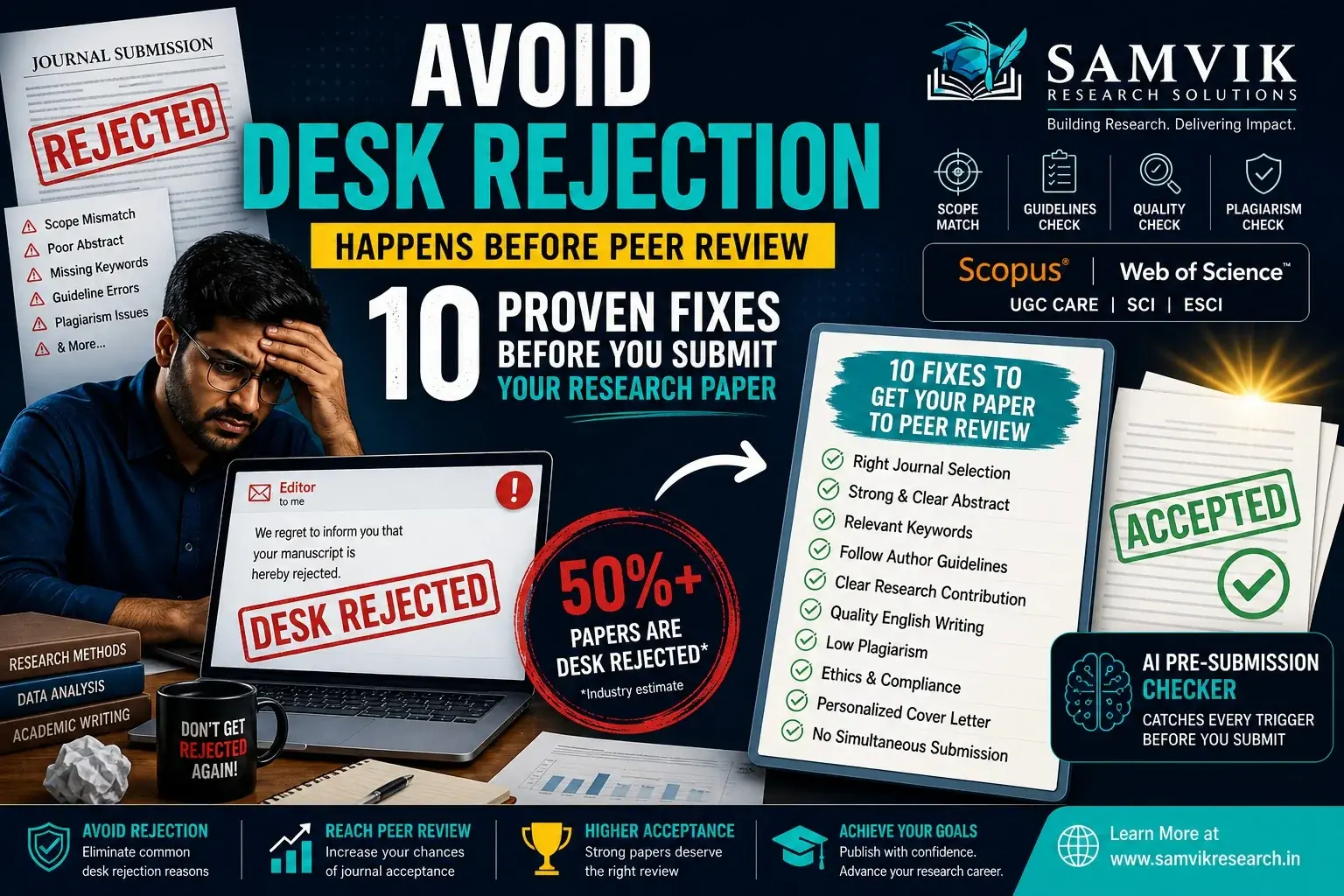
Imagine spending six months on your research. Writing, rewriting, asking your guide for feedback, formatting everything carefully — and then, five days after you submit, an email arrives. "We regret to inform you…" No reviewer comments. No suggestions. Just a rejection. That hollow feeling has a name: desk rejection. And it's painfully common among Indian PhD scholars.
We hear this story at SAMVIK constantly — from scholars in Meerut, Lucknow, Delhi, Hyderabad, across every discipline. And every single time, when we look at the manuscript, the problem wasn't the research. It was something entirely fixable that happened before or during the submission process.
This guide is our honest attempt to make sure it doesn't happen to you again.
So What Exactly Is a Desk Rejection?
A desk rejection happens when the Editor-in-Chief or an Associate Editor decides your paper is not suitable for peer review — and sends it back to you, usually within 3 to 14 days of submission. No reviewer ever saw it. No detailed feedback is given.
It's called a "desk" rejection because the editor makes this call at their desk, often spending under 15 minutes on a quick scan of your cover letter, abstract, keywords, references, and formatting.
Here's what a desk rejection is not: it is not a verdict on the quality of your research. It is not a comment on your intelligence or your work ethic. It is almost always a process problem. And process problems have process solutions.
Desk Rejection vs Peer Review Rejection: What's the Difference?
One of the most common questions PhD scholars ask us is: "Is a desk rejection worse than a peer review rejection?" The answer — perhaps surprisingly — is no. Understanding the difference between the two is one of the most important journal submission tips for PhD scholars, because it changes how you respond and what you fix.
| Factor | Desk Rejection | Peer Review Rejection |
|---|---|---|
| When it happens | Within 3–14 days of submission | After 2–6 months of review |
| Who decides | Editor-in-Chief or Associate Editor | 2–4 external peer reviewers + editor |
| Feedback given | Minimal or none | Detailed reviewer comments |
| Reason | Process / fit / formatting issues | Methodology, contribution, analysis gaps |
| What it means | Your paper didn't pass the editorial filter | Your research was evaluated but found lacking |
| How to respond | Fix process issues, resubmit to a better-fit journal | Revise based on reviewer comments, resubmit |
| Impact on reputation | None — leaves no record anywhere | None — also confidential |
| Silver lining | Fast feedback; saves months of waiting | Free expert critique of your work |
The key insight here is that desk rejection is almost always about presentation and process, not the quality of your science. Peer review rejection, on the other hand, means your paper reached qualified experts — and that is actually something to build on. The reviewer comments, painful as they are, tell you exactly what needs strengthening. This is also why understanding why research papers get rejected at both stages matters so much: the fixes are completely different, and confusing one for the other means you spend time solving the wrong problem.
What if you could catch every desk-rejection trigger before the editor does?
SAMVIK is building an AI-powered Pre-Submission Checker specifically for Indian research scholars. Before you click Submit, our tool analyses your manuscript against your target journal's actual requirements — and flags every issue that could get you desk-rejected.
- Scope alignment check — does your paper actually fit the journal's Aims & Scope?
- Abstract quality score — is your research gap, method, and contribution clearly stated?
- Keyword relevance analysis — are you using the right indexed terms for your field?
- Author guidelines compliance — word count, reference style, section structure
- Plagiarism risk flag — estimates similarity risk before you run iThenticate
- Cover letter strength checker — does your letter make the case for this specific journal?
10 Reasons Journals Desk-Reject Your Paper — And Exactly How to Fix Each One
We've reviewed hundreds of rejected manuscripts from Indian scholars. The same problems appear again and again. Here they are — with honest explanations and practical fixes you can apply today.
You Submitted to the Wrong Journal
This is the single biggest cause of desk rejection among Indian scholars — and the most preventable. Sending a paper on "consumer trust in digital payments among rural Indians" to a journal whose scope is "management science and operations research" is an instant rejection. Every time. Without exception.
Most scholars pick journals based purely on impact factor or UGC CARE listing without checking whether their specific research actually fits. Editors have been reading their journals for years. They know within one paragraph whether a paper belongs there.
Your Abstract Doesn't Do Its Job
Here's something most scholars don't realise: at the desk stage, your abstract is almost certainly the only section the editor reads in full. If it doesn't clearly communicate your research problem, what you did, what you found, and why it matters — you will be rejected before the editor reaches your introduction.
A very common pattern in papers from Indian universities is the "descriptive abstract" — one that says "This paper examines the relationship between X and Y in the context of Z" without actually telling you what that relationship is. An editor reading this learns nothing useful. That's a desk rejection waiting to happen.
Your Keywords Are Generic or Missing Entirely
Keywords do two things: they help Scopus and Web of Science index your paper correctly, and they signal to the editor that you understand your field's vocabulary. If your keywords are vague — "research," "India," "analysis," "qualitative study" — that's a red flag. If they're missing entirely, that's worse.
You Didn't Read the Author Guidelines
Every journal publishes detailed author guidelines — word limits, reference style, heading structure, figure resolution, number of tables. Many editors run a compliance check at the desk stage. A paper that violates these guidelines communicates one thing: the authors haven't bothered to read our requirements.
We've seen papers desk-rejected because the bibliography was in APA when the journal required Harvard, or because the paper was 9,800 words for a journal with a 7,000-word limit. These are not content problems. They are entirely avoidable process failures.
Your Research Contribution Is Buried or Unclear
The question every editor asks at the desk stage is simple and brutal: "What does this paper add that we don't already know?" If the answer isn't clear within the first two pages — specifically in your abstract and introduction — the paper gets sent back.
This is especially common when PhD scholars convert thesis chapters into journal papers without reframing them for a journal audience. In a thesis, the contribution emerges gradually. In a journal paper, it must be declared explicitly and early.
Language Quality Issues
International journals expect publication-standard English. Grammatical errors, inconsistent tense, unclear sentence structures, and Indian-English constructions that don't translate to an international academic register — all grounds for desk rejection. This is one of the most common pain points for Indian scholars writing in their second or third language.
The frustrating part is that poor language can overshadow genuinely excellent research. An editor who has to work hard to understand what you're saying will often choose to pass.
Plagiarism Above the Journal's Threshold
Most Scopus-indexed journals use iThenticate. The moment you submit, your paper is automatically scanned. If your similarity index exceeds the threshold — typically 15–20% — your paper can be flagged before a human editor even opens it.
What catches many Indian scholars off guard is self-plagiarism. If you uploaded your PhD thesis to Shodhganga — which most Indian universities require — and you're now submitting a paper that reuses paragraphs from that thesis, iThenticate will flag it. Your own prior work counts as a source.
Missing Ethics or Data Availability Statement
Since 2020, most reputed journals have made ethics statements mandatory — especially for empirical studies involving human participants, surveys, or clinical data. Many papers from Indian scholars are desk-rejected on this basis alone, simply because the authors were unaware the requirement existed.
A Generic or Missing Cover Letter
Ask most Indian scholars what they wrote in their cover letter and the answer is something like: "Dear Editor, Please find attached my manuscript. I hope it is suitable for publication. Regards." That is not a cover letter. That's a formality being treated as a formality — and editors know immediately.
Your cover letter is your first real communication with the editor. It sets the tone. It makes the case. A weak cover letter signals a scholar who hasn't thought carefully about fit — which raises the probability of desk rejection before the editor even opens the manuscript.
Simultaneous Submission to Multiple Journals
Sending the same paper to two or more journals at the same time is a serious violation of publishing ethics — and journals check for it. If an editor discovers your paper is simultaneously under review elsewhere, it will be desk-rejected immediately, and your name may be flagged across the publisher's entire system.
Journal Desk Rejection: All 10 Causes at a Glance
| # | Cause | Risk | Quick Fix |
|---|---|---|---|
| 1 | Wrong journal scope | Very High | Read Aims & Scope + cite 3 papers from that journal |
| 2 | Weak or vague abstract | Very High | Rewrite using 4-part structure: Problem → Method → Results → Implications |
| 3 | Generic or missing keywords | High | Use 5–8 field-specific indexed terms matching recent journal papers |
| 4 | Author guideline violations | High | Build a compliance checklist from the journal's own guidelines |
| 5 | Unclear research contribution | Very High | State novel contribution in one explicit sentence in abstract + intro |
| 6 | Poor language / grammar | High | Professional proofreading; fix tense consistency throughout |
| 7 | Plagiarism above threshold | Very High | Pre-check similarity; rewrite all thesis-derived sections from scratch |
| 8 | Missing ethics / data statement | High | Add both statements even if formal ethics clearance wasn't required |
| 9 | Generic cover letter | High | Write a personalised letter citing 1–2 recent papers from that journal |
| 10 | Simultaneous submission | Very High | One journal at a time; maintain a submission log |
Common Desk Rejection Mistakes Indian Scholars Make — And Why They Keep Happening
Understanding why research papers get rejected at the desk stage in India requires a bit of context. The academic system here creates specific pressures that don't exist in the same way elsewhere — and those pressures lead to predictable, repeatable mistakes. Here's an honest look at the patterns we see most often, particularly among scholars trying to figure out how to publish in Scopus journals for the first time.
Mistake 1 — Choosing a journal based on impact factor alone
Impact factor is important — but it tells you nothing about whether your specific research fits that journal's scope. Hundreds of Indian scholars submit to high-IF journals they've never actually read, hoping the prestige will carry the paper through. It doesn't. The scope mismatch gets caught at the desk within days.
Mistake 2 — Treating the cover letter as a formality
This is perhaps the most common avoidable mistake. Among our journal submission tips for PhD scholars, writing a journal-specific cover letter consistently delivers the most impact per hour spent. A cover letter that names recent papers from the target journal and explains exactly why your work extends their conversation changes how an editor reads your submission from the very first line.
Mistake 3 — Submitting thesis chapters directly as journal papers
A thesis chapter and a journal paper are two different genres of academic writing. A chapter can be 40 pages of thorough, cumulative argument. A journal paper needs to be 6,000–8,000 focused words with a single, sharp contribution declared upfront. Submitting an unrevised thesis chapter is one of the fastest routes to desk rejection — the structure, tone, and framing are all wrong for the format.
Mistake 4 — Not checking scope before selecting the journal
Many scholars in smaller universities and research institutions in India don't have ready access to mentors who know specific journals well. So they rely on ranked lists — UGC CARE lists, Scopus rankings — without doing the scope analysis. This is completely understandable, but it's the root cause of most wrong-journal desk rejections. The fix is simple: 20 minutes reading the journal's last 10 published papers before you decide to submit.
Mistake 5 — Ignoring self-plagiarism from Shodhganga
As discussed earlier, uploading your thesis to Shodhganga — mandatory for most Indian universities — means iThenticate will flag any reused paragraphs in your journal submissions. Many scholars, particularly those in regional universities where this isn't commonly taught, are completely unaware of this when they try to convert their thesis work into journal publications. It accounts for a significant proportion of avoidable desk rejections in India.
Checklist Before Journal Submission — Use This Every Time
Run through every item below before clicking Submit. This checklist is built directly from the 10 failure points above. It takes about 20 minutes and has saved dozens of SAMVIK clients from unnecessary rejections.
SAMVIK Anti-Desk-Rejection Checklist
- I have read the journal's full Aims & Scope — not just the title.
- I have read at least 3–4 recent papers from this journal and cited at least 3 of them in my manuscript.
- My abstract follows the 4-part structure: Problem → Method → Results → Implications.
- I have included 5–8 specific, field-relevant keywords matching terms used in this journal's recent papers.
- I have downloaded and read the full Author Guidelines for this specific journal.
- My manuscript is within the specified word count limit.
- All references are formatted in the required style (APA / Vancouver / IEEE etc.).
- My research contribution and novelty are stated explicitly in the Introduction — not buried in the Discussion.
- The manuscript has been proofread for grammar, tense consistency, and academic English quality.
- I have run a plagiarism check and my similarity score is below 15%.
- I have included an Ethics Statement and/or Informed Consent Statement (if applicable).
- I have included a Data Availability Statement.
- I have written a personalised, journal-specific cover letter — not a template.
- This paper is NOT currently under review at any other journal.
- All figures and tables are in the correct format and within the journal's specified limits.
- All authors are listed with correct affiliations and ORCIDs (where required).
A Note for Indian Scholars: UGC CARE, Scopus, and the Shodhganga Problem
On UGC CARE journals: The UGC CARE pool is large and quality varies significantly. Many journals in this pool receive extremely high submission volumes from Indian scholars, which means editors are particularly quick to desk-reject papers that feel generic — no India-specific context, no references to the journal's own published work. Your scope alignment and in-journal citations matter even more here than at international journals.
On Scopus journals: iThenticate runs automatically on submission. If your similarity score is above threshold, the system flags it before a human editor sees your paper. If you're learning how to publish in Scopus journals for the first time, this is one of the most critical technical realities to know — your paper can be eliminated before anyone reads a word of your actual research. Check your similarity before submitting. SAMVIK's AI tool estimates your plagiarism risk from your text before you spend money on an iThenticate report.
Stop guessing. Let our AI check your paper before the editor does.
SAMVIK's Research Pre-Submission Checker is being built for exactly this situation — an Indian scholar, under deadline pressure, trying to do everything right without always having the right guidance around them.
- Paste your abstract — get an instant structure and clarity score
- Enter your target journal — get a scope fit analysis in seconds
- Upload your reference list — check in-journal citations and format compliance
- Get a desk-rejection risk score — with specific, actionable fixes for each issue flagged
- Receive a personalised cover letter template tuned to your journal target
What to Do After a Journal Desk Rejection
Even if you follow everything in this guide, desk rejections still happen. Here's how to handle it productively.
1. Read the rejection email carefully — once
Some editors do give a brief reason. Map it to the 10 causes above. If no reason is given, look at your submission honestly and ask yourself which of the 10 issues might apply.
2. Give it 48 hours
Don't rush your paper to another journal the same day. 48 hours gives you emotional distance and a fresher reading of your own work. Have someone else review it during this time.
3. Choose your next journal deliberately
Don't just go down your ranked list. Do the scope analysis again for the next candidate. Read their recent papers. Make sure the fit is genuine before you invest another submission and more waiting time.
4. Rewrite the cover letter entirely
A cover letter written for Journal A will not work for Journal B. It must reference Journal B's specific papers, scope, and editorial priorities. Rewrite it from scratch — every time.
5. Remember: desk rejection leaves no trace
Unlike a peer-reviewed rejection, a desk rejection is not recorded anywhere in the academic system. It doesn't follow you. It doesn't affect your reputation with any other journal. Every researcher you admire has been desk-rejected. What matters is what you do next.
Frequently Asked Questions: Journal Desk Rejection
Your Research Deserves to Be Read.
Don't let a fixable process problem stop it at the editor's desk. SAMVIK offers pre-submission manuscript review, journal selection guidance, cover letter writing, and early access to our AI Pre-Submission Checker — built specifically for Indian PhD scholars.
Talk to a SAMVIK Expert Today →