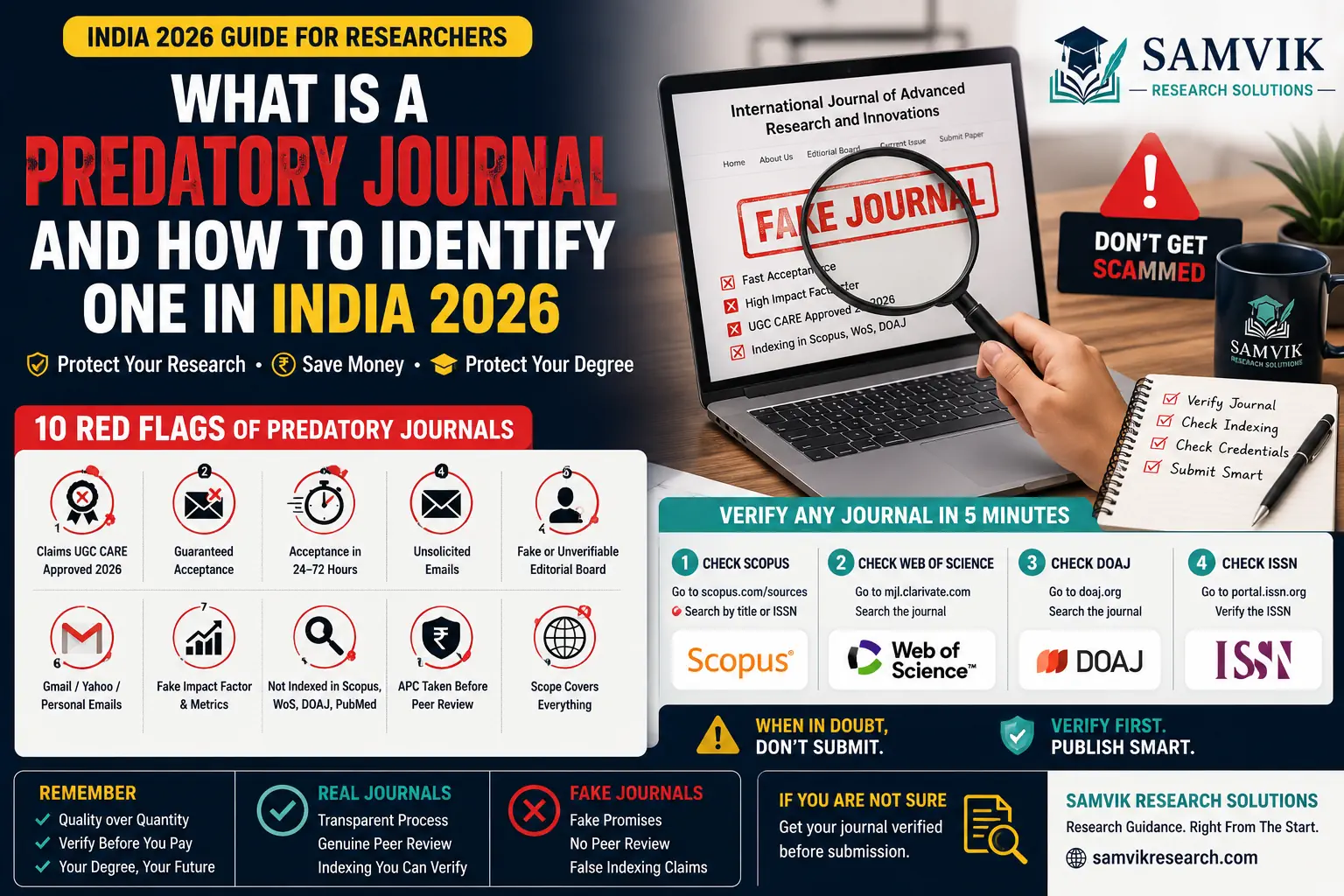

10Red flags that expose a predatory journal24–72hr"Acceptance" time that proves no real review2minTo verify any journal across 4 official sourcesFeb2025UGC CARE list officially discontinued
A predatory journal is a fake academic journal that charges publication fees without providing genuine peer review, editorial oversight, or any real academic value. The paper gets published. The money leaves your account. And when your university checks the journal, nothing counts.
This is happening to thousands of Indian PhD scholars every year — and since the UGC CARE list was discontinued in February 2025, it is getting worse. This guide tells you exactly how to identify a predatory journal, how to verify any journal before you submit, and what to do if you have already published in one.
⚠️ The new 2025 scam: Since the UGC CARE list was discontinued, predatory publishers have added a powerful new tactic — falsely claiming to be "UGC CARE approved 2026." This is impossible. The UGC CARE approval system no longer exists. Any journal making this claim is lying, and deliberately targeting scholars who do not yet know the list was discontinued.Why Indian PhD Scholars Fall for Predatory Journals
The demand is understandable. Indian PhD programmes require publication before thesis submission. Faculty face API scoring deadlines. Time is short. Legitimate indexed journals have review cycles of two to six months. Predatory publishers offer acceptance in days — at a price that feels manageable when you are under pressure.
Predatory publishers have built their entire business model around this pressure. They study the Indian academic system, target scholars at critical submission moments, and design their communications to look exactly like genuine journals.
Difference Between a Predatory Journal and a Low-Quality Journal
This distinction matters because they require different responses.
| Factor | Low-Quality (but legitimate) Journal | Predatory Journal |
|---|---|---|
| Peer review | Real, but not rigorous | None, or fabricated |
| Indexation | Indexed in a recognised database | False or unverifiable claims |
| Editorial board | Real, identifiable | Does not exist or is fabricated |
| The fee (APC) | Charged for a real service | Collected in exchange for nothing |
| Does it count? | Usually counts for institutional requirements | Counted by no reputable institution |
| Verdict | Weak career move — but legitimate | Fraud — permanent reputation risk |
10 Red Flags of a Predatory Journal
We have reviewed hundreds of journal solicitations sent to Indian scholars. The same warning signs appear again and again. If a journal shows even two or three of these, stop and verify before you submit.
RED FLAG 01It claims to be "UGC CARE approved 2026"
The list was discontinued on 11 February 2025. This claim is impossible — and an instant signal that the journal is lying about its credentials.
RED FLAG 02It guarantees acceptance before reviewing your paper
The decision was made before anyone read your work. That is not peer review — it is a sales transaction.
RED FLAG 03It accepts papers within 24 to 72 hours
Legitimate peer review takes weeks at minimum. Same-day or same-week acceptance means no review happened.
RED FLAG 04It sends you an unsolicited invitation email
The email says the journal "noticed your previous work" and invites you to submit. This is bulk-targeted marketing. Legitimate journals do not recruit authors this way.
RED FLAG 05The editorial board cannot be verified
Board members are either unnamed or cannot be found at their stated institutions. A fabricated editorial board is one of the most reliable indicators of a predatory publication.
RED FLAG 06It uses a Gmail, Yahoo, or personal email address
An academic journal operating without an institutional email domain is not an academic institution.
RED FLAG 07It claims an Impact Factor not verifiable at Clarivate
Impact Factor is calculated by Clarivate Analytics and is only valid if it appears at mjl.clarivate.com. Predatory journals invent metrics called "Global Impact Factor" or "Indian Research Index" — these are not real.
RED FLAG 08It cannot be found on Scopus, WoS, DOAJ, or PubMed
If it claims indexation that cannot be independently verified, the claim is false.
RED FLAG 09The APC is collected before peer review is complete
Legitimate journals collect fees after acceptance. Predatory journals collect upfront because acceptance is guaranteed regardless.
RED FLAG 10The journal scope covers every discipline
"International Journal of Science, Technology, Engineering, Management and Humanities" is not a scope. Legitimate journals have a specific disciplinary focus.
Common Fake Journal Emails Indian Scholars Receive
Recognising the pattern protects you from clicking through in the first place. The most common opening line is some version of: "We read your recently published paper with great interest and would like to invite you to submit your next research to our esteemed journal." The email goes on to list a rapid review timeline, a low APC, and an upcoming issue deadline to create urgency.
Other common variations include: "Your profile indicates expertise in our journal's scope" — which means your name was scraped from a university website or a previous publication. Or: "We are pleased to inform you that our journal is indexed in Scopus and UGC CARE" — which should immediately trigger the verification steps below.
A genuine journal you are appropriate for will surface through your own literature search, through your guide's recommendations, or through colleagues in your field — never through a cold email.How to Check If a Journal Is Scopus Indexed
Go to scopus.com/sources and search by the journal's full title or its ISSN number. If the journal appears with the status marked as Active, it is currently Scopus indexed. If it appears as Discontinued or Temporarily Not Available, it has been removed or suspended. If it does not appear at all, it is not Scopus indexed — regardless of what the journal's website claims.
Always verify at the time of submission, not when you started writing. Scopus periodically reviews its indexed journals and removes those that no longer meet quality criteria. Screenshot the Scopus source page showing Active status on the date you submit — this documentation matters if a journal is later delisted before your thesis evaluation.
How to Verify a Web of Science Journal
Go to mjl.clarivate.com and search by title or ISSN. Web of Science covers four main lists — SCI (Science Citation Index), SSCI (Social Sciences Citation Index), AHCI (Arts and Humanities Citation Index), and ESCI (Emerging Sources Citation Index). A journal claiming SCI or SSCI indexation that does not appear on this list is making a false claim.
Note that ESCI journals are included in WoS but do not yet have Impact Factors. Some Indian universities accept ESCI publications and others do not — verify your institution's specific position before submitting to an ESCI journal.
Verify in Under 2 MinutesThe 4-source check that beats every predatory claim
These four sources are free, official, and take less time than writing the submission email. If a journal fails all four checks, do not submit — regardless of what the journal's website says.
Scopus — verify Active status at scopus.com/sources
Web of Science — search title/ISSN at mjl.clarivate.com
DOAJ — check open access journals at doaj.org
ISSN Portal — confirm the ISSN at portal.issn.org
Reputation search — search the journal name alongside "predatory" or "scam"
Are All Paid Journals Predatory?
No. Article Processing Charges (APCs) are a standard feature of legitimate open access publishing. Many high-quality Scopus-indexed and WoS-indexed journals charge APCs — including journals published by Elsevier, Springer, Wiley, and Taylor & Francis. What distinguishes a legitimate APC from a predatory one is that the legitimate journal provides genuine peer review, has verifiable indexation, and the charge is collected after acceptance.
The presence of an APC alone does not make a journal predatory. The absence of genuine peer review, verifiable indexation, and a real editorial process does.
Can Scopus Journals Be Fake?
A journal cannot be fake and appear on Scopus with Active status simultaneously — Scopus vets journals before including them. However, journals can be removed from Scopus after inclusion if they fail re-evaluation. Some predatory journals have been included briefly before being identified and delisted.
The more common scenario is a journal falsely claiming Scopus indexation. Always verify at scopus.com/sources yourself rather than accepting the journal's claim.
List of Common Fake Journal Claims in India
| The Claim | Reality | Risk |
|---|---|---|
| "UGC CARE approved 2026" | Impossible — the list was discontinued February 2025 | Definite Scam |
| "Scopus indexed" (not at scopus.com/sources) | False claim — verify the source page yourself | Very High |
| "Impact Factor 3.5" (no Clarivate listing) | Fabricated metric | Very High |
| "Peer reviewed within 7 days" | Genuine peer review does not happen in seven days | Very High |
| "Indexed in Google Scholar" | Google Scholar is a search engine, not a quality index — this claim is meaningless | High |
| "Published by an international publisher" | A professional-looking website proves nothing — verify the ISSN at portal.issn.org | High |
What Happens If You Publish in a Predatory Journal
In the best case, the publication is not counted and you lose the APC. In worse cases, a thesis evaluation committee requires additional publications in legitimate indexed journals before approving submission. At institutions with strong integrity frameworks — central universities, IITs, NAAC-accredited institutions — publishing in a known predatory journal after guidance can be treated as research misconduct.
The APC is almost never recoverable. Predatory publishers do not refund, do not respond to complaints, and frequently disappear within a few years — taking your paper with them.
What to Do After Publishing in a Predatory Journal
First, check whether the journal currently appears on Scopus or WoS. If it does, it may still be accepted by your institution despite other concerns.
If it does not, speak to your guide or research cell immediately. Explain the situation honestly. In most cases, the practical path forward is publishing a new manuscript in a legitimate indexed journal rather than attempting withdrawal from the predatory one. Withdrawal requests rarely succeed — predatory publishers have no functional editorial process.
If the same research needs to be published elsewhere, most legitimate journals will consider work previously posted in a predatory outlet as long as that outlet has no indexation in any significant database. Policies vary, so check with the target journal's editor before submitting.
Frequently Asked Questions: Predatory Journals
What is a predatory journal in simple terms?▾A predatory journal is a fake academic journal that charges researchers to publish their work while providing no real peer review, no legitimate editorial process, and no actual academic value. The publication looks real but is accepted by no reputable university, database, or institution.How do universities check for fake journals in India?▾During thesis evaluation, your research cell checks your publication against Scopus, WoS, DOAJ, and UGC historical lists. A journal not appearing in any legitimate database raises immediate questions. Some institutions also maintain internal lists of known predatory publishers that are specifically checked during evaluation.Can predatory journals appear on Google Scholar?▾Yes. Google Scholar automatically indexes content from across the internet including predatory journals, preprints, and grey literature. Being indexed on Google Scholar means nothing about a journal's legitimacy. Always verify at Scopus, WoS, DOAJ, or PubMed.Are all paid journals predatory?▾No. Many high-quality Scopus and WoS indexed journals charge Article Processing Charges. The issue is not payment — it is whether the journal provides genuine peer review, has verifiable indexation, and operates with a real editorial process.Is UGC CARE still valid in 2026?▾The UGC CARE list was discontinued in February 2025. No journal can be currently approved by it. The frozen historical list of 1,474 journals at ugc.gov.in carries no current endorsement. For 2026, Scopus or WoS indexed journals are the safe standard.Can a Scopus indexed journal be predatory?▾A journal appearing on Scopus with Active status cannot simultaneously be predatory — Scopus vets journals before inclusion. However, predatory journals frequently claim Scopus indexation falsely. Always verify at scopus.com/sources yourself rather than accepting a journal's own claim.MDr. Megha GuptaResearch Manager – Life Sciences & Journal Reviewer (Cureus, IJCRT)Dr. Megha Gupta holds a PhD in Microbiology and serves as a peer reviewer for indexed journals. At SAMVIK Research Solutions she leads research quality assurance and journal selection guidance for Indian PhD scholars — with a focus on verifying genuine Scopus and WoS indexation and steering scholars away from fast-acceptance predatory outlets.Not Sure Whether a Journal Is Genuine?
Get your target journal verified before you submit. SAMVIK Research Solutions helps Indian PhD scholars verify current Scopus and WoS indexation, understand the post-UGC CARE publication landscape, select the right journal for their discipline, and prepare manuscripts that avoid the desk rejection issues that push scholars toward predatory outlets in the first place.
Get Your Journal Verified by SAMVIK →Related reading: Scopus vs WoS vs UGC CARE — Which Journal Should You Target · UGC CARE 2025 — What Replaced It · How to Avoid Desk Rejection