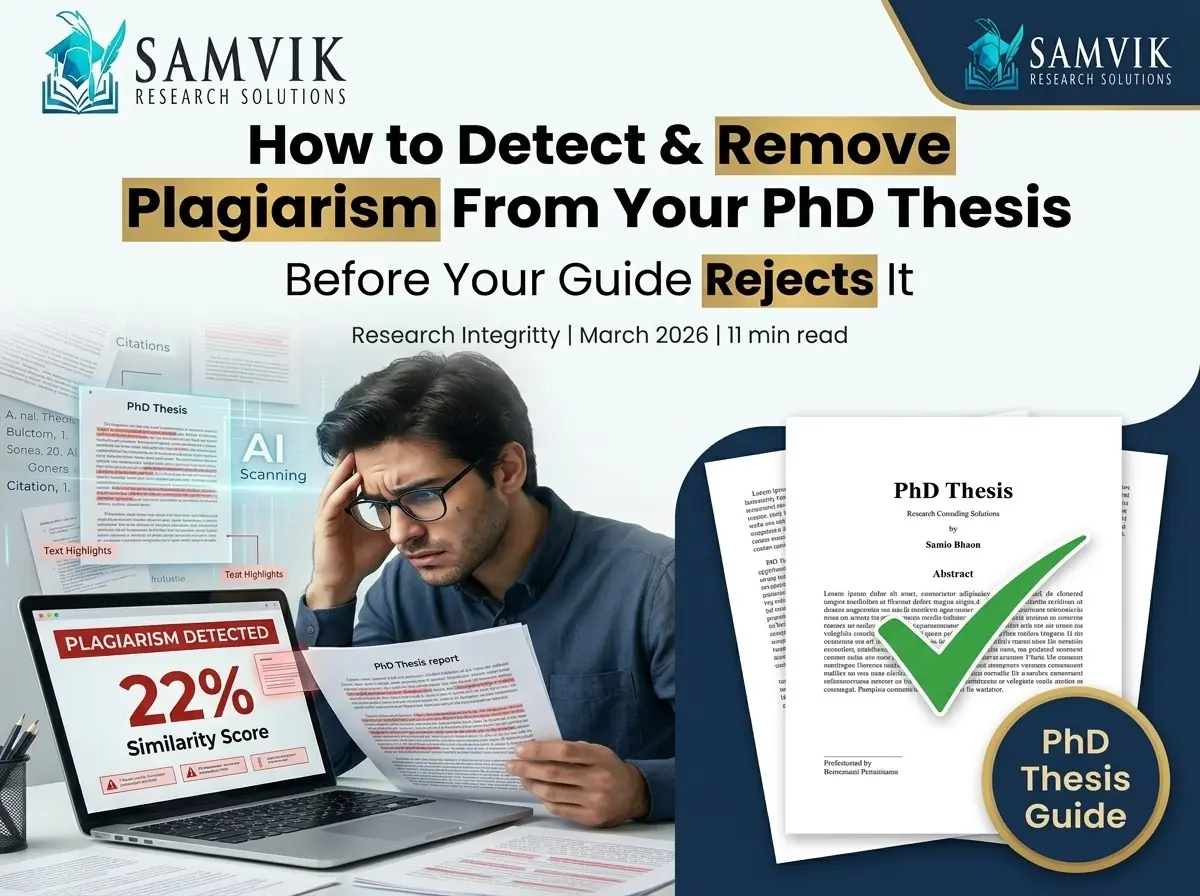
Imagine spending two years on your PhD thesis. Hundreds of hours of reading, writing, rewriting, collecting data, running analysis. You submit the draft to your guide with quiet confidence — and two days later, you get it back with a single line: "Similarity index is 22%. Bring it down before I can forward it." No explanation of where the problem is. No guidance on how to fix it. Just a number and a rejection. This scenario plays out in universities across India every single month. And in most cases, the scholar did not intend to plagiarise anything. They simply never learned how to avoid it. This guide changes that.What we cover
What plagiarism actually means in research
The handwoven fabric — understanding originality
Six types of plagiarism scholars overlook
What UGC says — the rules Indian scholars must know
Nine habits that keep your thesis clean
How to paraphrase properly — and how not to
Tools to check before you submit
FAQs
What Plagiarism Actually Means in Research
Ask ten PhD scholars what plagiarism means and most will say: copying someone else's words without giving credit. That definition is correct — but it is dangerously incomplete. Because it covers only the most obvious kind. And the most obvious kind is actually the least common cause of high similarity scores in Indian theses.
Plagiarism, in the full academic sense, means presenting someone else's intellectual contribution — their words, their ideas, their data, their structure, their argument — as your own, without proper acknowledgement. The key phrase is intellectual contribution. It goes far beyond sentences.
You can plagiarise an idea while using entirely original words. You can plagiarise a framework while never quoting a single line. You can even plagiarise your own past work — and yes, that is a real thing, with real consequences.
The Handwoven Fabric
AnalogyThink of your thesis like a piece of handwoven fabric — the kind made in Varanasi or Pochampally, where each weaver develops their own pattern over years of learning. You are absolutely allowed to study other weavers. You can observe their techniques, understand their patterns, even acknowledge their influence openly in your work. But the fabric itself — every thread of argument, every knot of analysis, every colour of original thought — must come from your own hands and your own mind. The moment you lift threads from someone else's cloth and weave them in as your own, without saying so, that is plagiarism. Even if you changed the colour slightly. Even if you only took a small piece.This is why intention does not fully protect you. Accidental plagiarism — caused by poor note-taking, forgotten citations, or misunderstood paraphrasing — is still plagiarism under UGC regulations. The only complete protection is building the right habits from the first day of your research.
Six Types of Plagiarism Scholars Overlook
1. Paraphrasing without citing
This is the single most common cause of high similarity scores in Indian PhD theses. A scholar reads a paragraph, rewrites it in different words, and genuinely believes that rewriting makes it original. It does not. The idea still belongs to the original author. Rewriting without attribution is plagiarism — softer than copy-pasting, but equally penalised by detection tools and viva panels.
2. Mosaic writing
You take a phrase from one paper, a sentence structure from another, and a conclusion from a third — and stitch them into a paragraph that looks original on the surface. Turnitin and iThenticate are extremely good at catching this. Mosaic writing is sometimes called "patchwork plagiarism" and it is far more common than most scholars realise.
3. Self-plagiarism
You wrote an excellent M.Phil dissertation two years ago. Some of those chapters feel relevant to your PhD. So you copy a few pages across — after all, it is your own work, right? Wrong. Submitting previously assessed work without disclosing it is considered self-plagiarism under UGC guidelines.
A real situationA scholar in a central university in Madhya Pradesh submitted her PhD thesis after four years of work. Her similarity score came back at 18% — nearly half of which was traced to her own M.Phil thesis from the same institution. She had copied her literature review almost entirely, believing her own earlier work was safe to reuse. Her submission was delayed by eight months while she rewrote those chapters from scratch. Eight months. For work she had already done once.4. Borrowed structure
You read a brilliant paper and unconsciously follow its exact logical flow — the same argument sequence, the same section order, the same progression of ideas — even though every individual sentence is your own. This is structural plagiarism and it is one of the hardest forms to detect with software, but one of the easiest for an experienced examiner to spot during a viva.
5. Uncited data, figures, and statistics
Using a statistic, table, graph, or data point from another study without citing it is plagiarism — even if you reproduce the data in your own chart or table. Every number that did not come from your own original data collection needs a source.
6. Translation plagiarism
Indian researchers often consult Hindi, Tamil, Marathi, Telugu, or other regional language sources and then write about those ideas in English. Because the language has changed completely, it can feel like original writing. It is not. If the intellectual contribution came from a source — regardless of what language that source was in — it needs attribution. Translation is not transformation.
A note on AI-generated contentUsing AI tools like ChatGPT to write sections of your thesis and submitting them as your own work is increasingly treated as a form of academic dishonesty by Indian universities — separate from traditional plagiarism but equally serious. AI detection tools are now widely used alongside plagiarism checkers. The safest position: use AI to think, outline, and improve your drafts, but ensure the actual research thinking and writing is genuinely yours.What UGC Says — The Rules Indian Scholars Must Know
In 2018, the University Grants Commission of India introduced the UGC (Promotion of Academic Integrity and Prevention of Plagiarism in Higher Educational Institutions) Regulations. These are not suggestions. They are binding rules that every affiliated university is required to implement.
Under these regulations, plagiarism is classified into four levels based on the percentage of similarity detected:
| Similarity level | Percentage | Consequence |
|---|---|---|
| Level 0 — Minor | Up to 10% | Generally acceptable; no action required |
| Level 1 — Moderate | 10% to 40% | Resubmission required within a stipulated period |
| Level 2 — Serious | 40% to 60% | Debarred from submitting for one year; must resubmit revised work |
| Level 3 — Severe | Above 60% | Registration cancelled; no resubmission permitted for the same work |
These percentages are calculated after excluding the bibliography, direct quotations within prescribed limits, and text in the preliminary pages. Many universities apply even stricter internal thresholds — some set their acceptable limit at 7% or lower. Always confirm your institution's specific rules with your research committee before submitting any chapter.
SAMVIK TipDo not wait until your full thesis is complete to run a plagiarism check. Check chapter by chapter as you write. Catching a 14% score in Chapter 2 while you still have six months to revise is a very different situation from catching it three weeks before submission.Nine Habits That Keep Your Thesis Clean
1 Read fully, close the source, then write
This single habit prevents more unintentional plagiarism than any other. Do not write while a paper is open in front of you. Read it completely. Understand it. Close it. Then write what you understood — in your own voice, from your own comprehension.
2 Keep two completely separate sets of notes
Maintain one notebook for direct quotes — every entry must have quotation marks and a full citation. Keep a second notebook for your own reflections, summaries, and paraphrases. Never mix the two.
3 Cite in the moment, not at the end
The most well-intentioned scholars tell themselves they will "add citations later." Later, they cannot remember where a particular statistic came from. Add every citation the moment you use the idea. This takes three extra seconds while writing. It saves hours of panic before submission.
4 Use a reference manager from day one
Zotero is free. Mendeley is free. Both integrate directly with Microsoft Word and Google Docs. Every time you read a paper, add it to your library. Running out of citations at submission time — a completely avoidable crisis — simply does not happen to scholars who use these tools consistently from the start.
5 Understand the difference between paraphrasing and disguising
True paraphrasing means you have genuinely reprocessed an idea through your own understanding and expressed it in your own sentence structure and voice. Swapping synonyms while keeping the same skeleton is not paraphrasing. It is disguised copying, and it is precisely what modern detection algorithms are designed to catch.
6 Quote directly — but rarely, and purposefully
A precise legal definition, a famous theoretical statement, a specific claim you are about to challenge — these are moments where quoting is appropriate. Outside of these moments, paraphrase and cite. Theses loaded with direct quotations often score high on similarity checks.
7 Be extra careful with regional language sources
Translating a Hindi or Tamil source into English does not make the ideas original. If the intellectual content came from someone else, cite them regardless of the language.
8 Disclose your own previous work
If you are building on your M.Phil dissertation, a published conference paper, or any previously submitted work — say so explicitly. Cite yourself the same way you would cite any other source.
9 Run your own check before your guide does
Take ownership of your thesis's originality. Before submitting any chapter to your supervisor, check it yourself. Discovering a problem yourself and fixing it is a sign of academic maturity.
How to Paraphrase Properly — and How Not To
Analogy — The Two CooksImagine two cooks given the same recipe. The first cook reads it carefully, understands the technique, sets the recipe aside, and then cooks entirely from memory — adjusting the spices to their own taste. The second cook keeps the recipe open throughout, following each line exactly. The first cook's dish is original work inspired by a source. The second cook has simply reproduced someone else's creation. In research writing, you are always trying to be the first cook.Here is a concrete example of the difference between disguised copying and real paraphrasing:
| Original text | Disguised copying — still plagiarism | Genuine paraphrasing — with citation |
|---|---|---|
| "Climate change has significantly altered rainfall patterns across South Asia, leading to increased frequency of extreme weather events and threatening agricultural productivity in vulnerable regions." | "Climate change has considerably changed precipitation patterns across South Asia, resulting in higher frequency of extreme climate events and endangering farm output in susceptible areas." | Research indicates that shifting climate conditions in South Asia are disrupting the regularity of monsoons and intensifying weather extremes, with serious implications for food security in already-stressed farming communities (Author, Year). |
Notice that the disguised version changes words but keeps the same sentence structure and logical movement. The genuine paraphrase reconstructs the idea from scratch in a completely different sentence architecture — and still carries the citation.
Tools to Check Before You Submit
| Tool | Best for | Availability in India |
|---|---|---|
| Turnitin | Gold standard for university submission checks; most widely accepted | Usually available through your institution's subscription |
| iThenticate | Research papers being submitted to journals | Paid; widely used by Indian publishers and research institutions |
| Unicheck | Independent researchers needing affordable per-page checking | Affordable paid plans available online |
| Grammarly Premium | Quick plagiarism scan combined with grammar improvements | Subscription-based; monthly plans available |
| SAMVIK Originality Tool | AI-powered analysis with rewriting suggestions — designed for Indian scholars | Free to use at samvikresearch.com |
Frequently Asked Questions
What similarity percentage is acceptable for a PhD thesis at Indian universities?
Under UGC's 2018 regulations, up to 10% similarity (after excluding bibliography and direct quotes) is considered acceptable at the national level. However, many institutions have set their own internal threshold lower, at 7% or even 5%. The only reliable answer is the one your own institution gives you.
Can I cite myself? Is self-plagiarism really taken seriously?
Yes, and yes. Self-plagiarism is taken very seriously, particularly at institutions that have implemented UGC's 2018 guidelines in full. If you are reusing your own previously submitted or published work, cite it the same way you would cite any other source.
I paraphrased everything. Why is my similarity score still high?
Because paraphrasing does not eliminate similarity — it reduces it. Detection software compares not just word matches but phrase patterns, sentence structures, and logical sequences. A score of 4–6% after proper paraphrasing and citation is entirely normal and expected.
My guide says I need to "reduce my similarity score." Where do I even start?
Start with the highest-flagged sections first — usually the literature review and introduction. For each flagged section, go back to the original source, re-read it properly, close it, and rewrite from your own understanding with a citation added. Do not just swap synonyms — restructure the sentence entirely.
Is it plagiarism to use data or statistics from government reports without citing them?
Yes. Government reports, census data, NSSO surveys, RBI publications — all of these are authored sources and require citation even though they are publicly available. "Publicly available" does not mean "citation-free."
How is SAMVIK Research Solutions different from services that just "reduce similarity scores"?
There is a significant difference between reducing a number and building genuine originality. At SAMVIK, we work on the substance — helping scholars understand what needs to be rewritten and why, improving their paraphrasing skills, strengthening their analytical voice, and ensuring the final thesis reflects their own thinking.