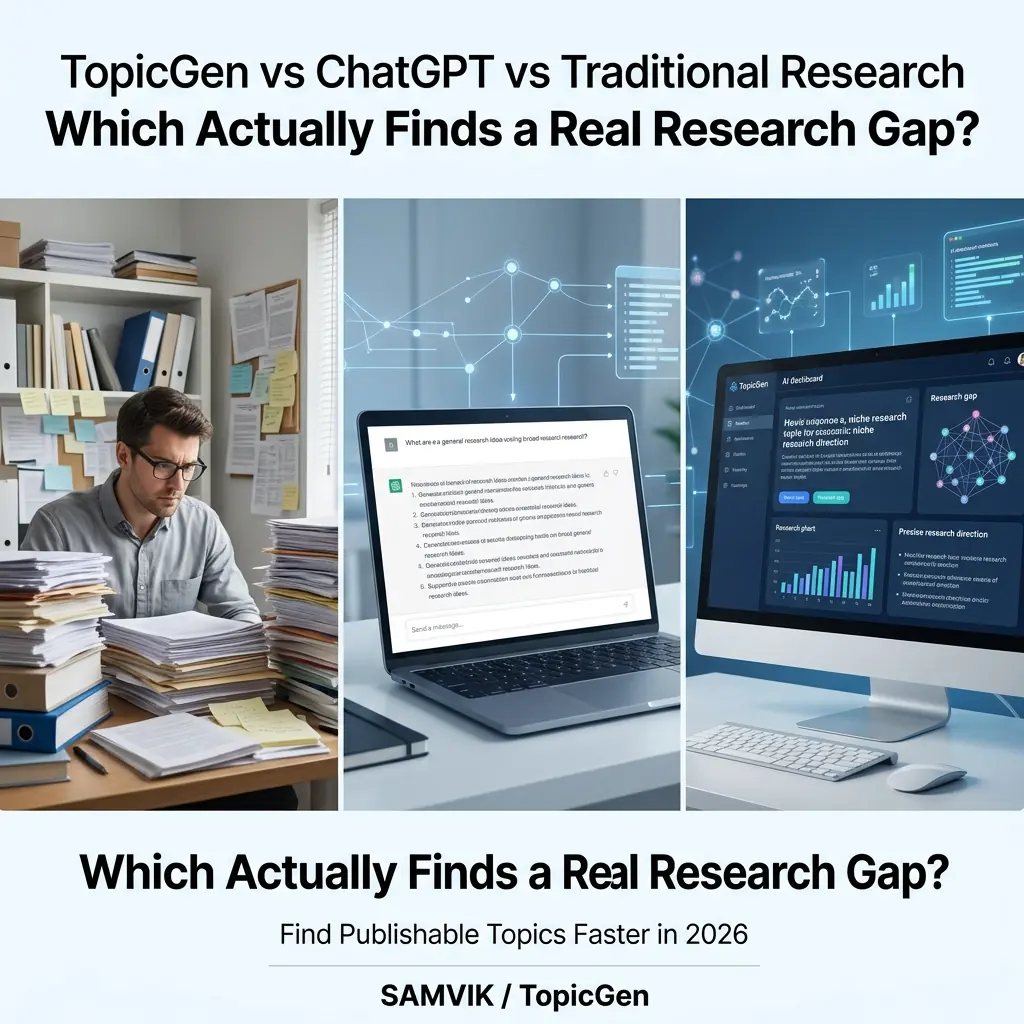

If you've been searching online for how to find a research topic, you've seen the same three lines on every website: read journals, talk to your supervisor, look for gaps in the literature.
That advice is not wrong. It is just incomplete — and in 2026, it is also too slow for most scholars working with real deadlines.
Today you actually have choices. You can dig through papers the old-fashioned way. You can ask ChatGPT for ideas. Or you can use a purpose-built tool like SAMVIK AI TopicGen, which was designed for one thing — finding an original, gap-backed research topic quickly. The question is which of these actually works when a PhD or Masters scholar is sitting in front of a blank page trying to finalise a topic their supervisor will approve.
I've worked with enough scholars to know that this is where most research projects either take off or stall. So let me walk you through each approach honestly — the strengths, the weaknesses, and how I personally combine them.
The Traditional Method — Thorough, But Painfully Slow
Let's begin with the old way, because it still works and you need to understand why before comparing it with anything else.
The traditional approach looks like this: pick a broad domain you are interested in. Read a few review articles. Track citations. Note down which problems keep coming up and which ones have stopped getting attention. Slowly, a mental map of the field starts to form — and if you are patient and lucky, a gap begins to emerge from that map.
Done well, this produces excellent research. The thinking is deep, the evidence is nuanced, and the topic sits firmly on top of real literature. The problem is simply the time it takes.
ChatGPT — Fast, Versatile, and Not Built for This
Let me be fair to ChatGPT. It is a genuinely impressive tool, and I use it myself every week. But research topic generation is not what it was designed for, and the difference shows the moment you actually try it for this purpose.
Ask ChatGPT for PhD research topics in fintech and you will get ideas like digital financial inclusion, blockchain in banking, AI-driven credit scoring. These are real topics. They are also the topics that have been studied exhaustively for the past five years. A good reviewer will spot the lack of novelty in the first ten seconds of your proposal.
The reason is structural. ChatGPT has no mechanism for checking what the current literature already covers. It generates based on what is most discussed in its training data, which is the opposite of what you need — you need what is underexplored.
SAMVIK AI TopicGen — Built for One Specific Problem
SAMVIK AI TopicGen was not built to be a general-purpose AI. It was built to solve one specific, narrow problem — helping PhD, M.Phil, and Masters scholars find original, gap-backed research topics quickly and reliably.
Instead of generating text based on what is most commonly discussed, it looks at research patterns and surfaces what is underrepresented. That is the entire design philosophy.
What feels different when you actually use it
- You enter your domain and your research level — not just a keyword.
- The output is a topic plus a gap statement — you see why the topic matters, not just what it is.
- Topics are calibrated. A PhD gap, a Masters gap, and an M.Phil gap all look different because the tool treats them differently.
- Results come back in under 60 seconds, and the tool is free.
Gap: Existing studies focus on urban populations. Rural adoption behaviour, cultural barriers, and trust deficits among women investors remain largely unstudied.
Level & Direction: PhD · Behavioural finance + digital adoption + gender lens.
That is what I mean when I say it produces a research direction, not just a title. A scholar can walk into a supervisor meeting with that output and have a real conversation — instead of twenty generic ideas that go nowhere.
Side-by-Side Comparison
Here is how the three approaches stack up on the things that actually matter to a scholar.
| Feature | Traditional Method | ChatGPT | SAMVIK AI TopicGen |
|---|---|---|---|
| Primary purpose | Manual reading and synthesis | General-purpose AI | Built for academic research |
| Gap detection | Manual, weeks of reading | Not available | AI-driven gap analysis |
| Domain specificity | High, if you already know the field | Medium — generic | High — domain-aware |
| Output structure | Your own notes, unstructured | Topic list, no rationale | Topic + Gap + Level + Direction |
| Time to a usable result | Days to weeks | Minutes, but shallow | Under 60 seconds |
| PhD suitability | Yes — but exhausting | Risky — lacks depth | Yes — designed for it |
| Research quality | High if done correctly | Variable, unvalidated | High — gap-backed |
| Cost | Free (your time is the cost) | Free or paid plans | Free |
How It Compares With Other Research Tools
ChatGPT is not the only AI tool scholars use in 2026. It helps to understand where each tool actually fits in the research process, because most of them solve a different problem than topic discovery.
| Tool | Primary use | Gap detection? | Free? |
|---|---|---|---|
| SAMVIK AI TopicGen | Topic + gap + direction generation | Yes, built-in | Yes |
| ChatGPT / GPT-4 | General-purpose writing and brainstorming | No gap analysis | Free / Paid |
| SciSpace | Reading, summarising, Q&A on papers | Needs a paper first | Free / Paid |
| Elicit | Structured literature search | Partial — you find the gap | Free / Paid |
| Connected Papers | Visual mapping of related research | Needs a seed paper | Free / Paid |
| Research Rabbit | Citation tracking and discovery | Needs a seed paper | Yes |
| Semantic Scholar | AI-powered academic search | Search engine only | Yes |
| Google Scholar | Broad academic search and alerts | Fully manual | Yes |
Notice the pattern. Almost every tool on this list assumes you already have a topic and helps you read, map, or summarise the literature around it. SAMVIK AI TopicGen sits at an earlier point in the workflow — it helps you find your topic before you start reading.
The Best Workflow For 2026
The scholars who finish on time rarely pick one approach and stick to it. They use each tool at the stage where it is actually useful. This is the workflow I recommend:
- SAMVIK AI TopicGen — Identify a gap-backed topic in your domain. You should have a direction within a minute.
- ChatGPT or Claude — Reframe, rephrase, and draft your problem statement. Use it to write — not to decide.
- SciSpace, Elicit, or Google Scholar — Validate the gap against literature from the last 12 to 18 months. If too many papers already address your specific angle, adjust and rerun.
- Traditional literature review — Once the gap is confirmed, go deep. Build your theoretical framework properly, the way a committee expects to see it.
Which One Should You Actually Use?
The honest answer is that it depends on where you currently are in the process.
Use the traditional method when
- You are already deep into a literature review and need to go deeper.
- You are validating a gap you have already identified.
- You are building the theoretical framework of your thesis.
Use ChatGPT when
- You need to brainstorm variations around an idea you already have.
- You are drafting or rephrasing a problem statement.
- You want to see how your topic could be framed from a different angle.
Use SAMVIK AI TopicGen when
- You are starting from scratch and don't know what to research yet.
- You need a gap-backed topic quickly, not a generic list of ideas.
- You want to double-check whether your current topic is still original.
Related Reading
- SAMVIK AI TopicGen — Find Your PhD Research Topic & Gap in 30 Seconds
- 50+ Latest Research Topics with Gaps (2026) — Domain-Wise
- Why Many Research Papers Get Rejected
- Tense Use in Research Writing — A Section-by-Section Guide
Frequently Asked Questions
Is ChatGPT enough for research topic generation?
No. ChatGPT is excellent for brainstorming and writing, but it does not access real-time literature or identify genuine research gaps. It surfaces the topics that are most discussed in its training data — which is the opposite of what you need. Use it after you have a gap, not before.
What is the best tool for finding research gaps specifically?
SAMVIK AI TopicGen is one of the few tools built specifically for gap detection. It outputs a topic along with a gap statement and a research direction calibrated to your level. Tools like SciSpace, Elicit, and Connected Papers are great for working with literature — but they assume you already have a topic.
Can AI replace a literature review?
No. AI helps you start in the right direction faster — but validating a gap still requires reading recent papers. The most efficient workflow is AI for direction, and literature for validation.
How do I know if my research topic is truly original?
Search your topic plus the gap angle on Google Scholar and Scopus. Filter for the last 12 to 18 months. If fewer than three to five papers directly address your specific angle, the gap is likely still open. Then confirm it with your supervisor.
Which tool is best for PhD topic selection?
For PhD-level work you need a tool that gives you three things — a topic, a gap, and a direction. SAMVIK AI TopicGen is designed specifically for PhD, M.Phil, and Masters scholars and outputs all three in a single run.