
Most researchers don't struggle with ideas — they struggle with identifying a real research gap.
You might find a topic in minutes. But finding something publishable, original, and relevant in 2026? That usually takes weeks.
This guide solves that problem.
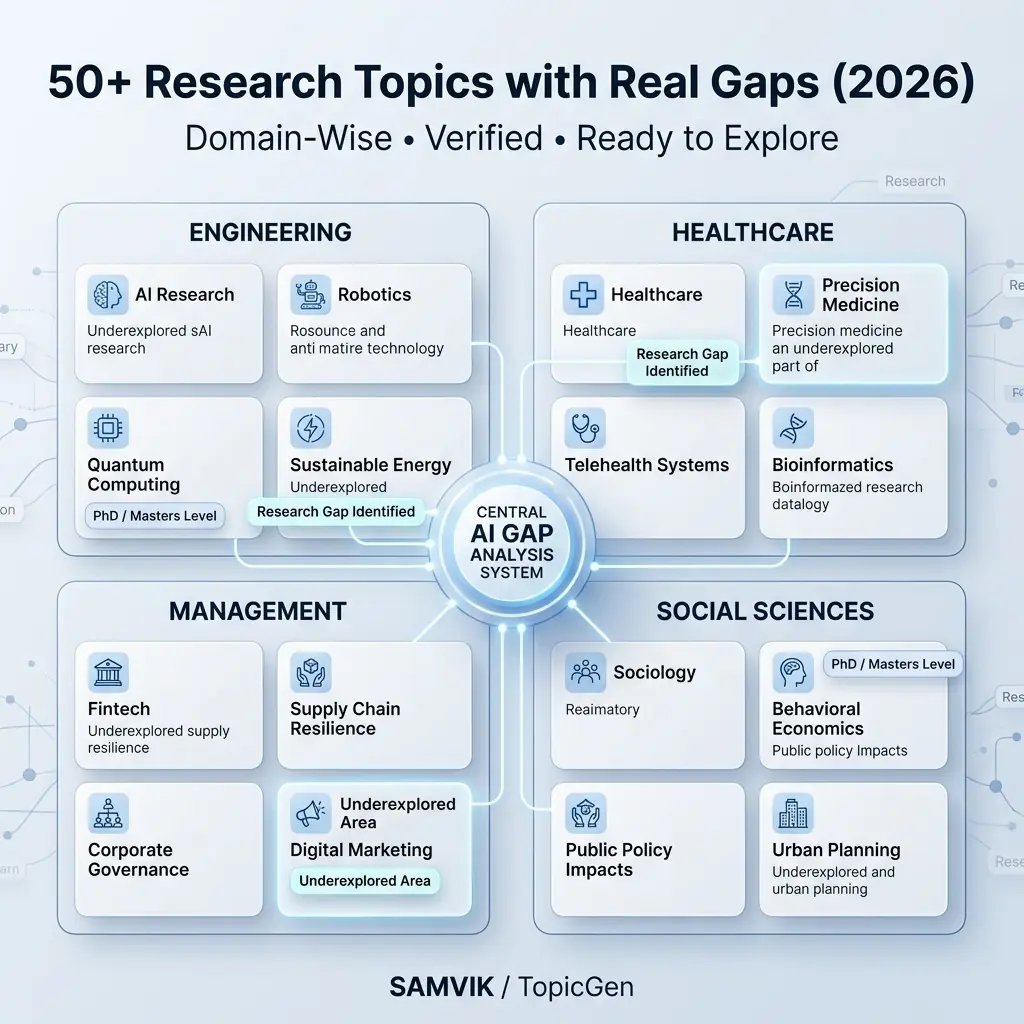
Here are 50+ latest research topics with clearly defined gaps — across Engineering, Life Sciences, Management, and Social Sciences — so you can start your research with clarity, not confusion.
What You'll Get From This Guide
Domain-wise research topics — Engineering, Healthcare, Management, Humanities
Clearly defined research gap for every topic
Suggested level — PhD / Masters / M.Phil
Keywords to validate your idea on Google Scholar or Scopus
Ready-to-use starting points for your research proposal or thesis
What is a Research Gap? (Quick Understanding)
A research gap is an area within a field that has not been adequately studied, explored, or validated.
It can be:
A missing population — e.g., rural vs urban, women vs men, elderly vs youth
A missing method — an established technique not yet applied to your problem
A new context — post-COVID settings, emerging technologies, new geographies
Conflicting results — where existing studies disagree and no one has resolved it
Finding the right gap = publishable research. That is the only formula that matters.
Before You Start Reading
If you want to generate custom topics based on your specific domain, or identify real research gaps instantly — use SAMVIK AI TopicGen.
It generates a topic, gap, and supporting research direction in under 60 seconds. It's free — and built specifically for PhD, M.Phil, and Masters students.
Use this guide to explore. Use SAMVIK AI TopicGen to go deeper.
What's Inside This Guide
Engineering — AI/ML, Cloud Computing, Cybersecurity, IoT, EV & Sustainability
Life Sciences & Medical Research — Clinical, Mental Health, Public Health & Epidemiology
Management — OB & HR, Strategy, Fintech & Financial Inclusion
Arts, Humanities & Social Sciences — Sociology, Gender, Language, Literature & Education
Engineering
Engineering research in 2026 spans AI, machine learning, cloud computing, IoT, cybersecurity, electric vehicles, and sustainable technology. The common thread across these sub-disciplines is a growing gap between lab-validated research and real-world deployment — particularly in emerging market and India-specific contexts.
Artificial Intelligence & Machine Learning
1. Bias Detection in Large Language Models for Low-Resource Indian Languages
↳ Gap: LLM bias research is almost entirely English-centric. Bias patterns in Hindi, Tamil, Bengali, and other Indian languages are largely unmeasured and unmitigated.
Level: PhD · KW: AI bias research topics 2026
2. Explainable AI in Clinical Decision Support Systems in Rural Healthcare Settings
↳ Gap: XAI adoption in clinical contexts is studied in urban hospitals. Rural and low-infrastructure settings — where clinical AI could have the greatest impact — are absent from existing validation studies.
Level: PhD / M.Phil · KW: explainable AI healthcare research gap
3. Federated Learning for Privacy-Preserving Fraud Detection in Indian Mobile Payment Ecosystems
↳ Gap: Federated learning fraud research focuses on Western banking systems. Application to UPI, mobile wallets, and MSME lending in India — with their unique data sparsity and regulatory context — is unexplored.
Level: PhD · KW: federated learning fintech research India
4. Multimodal AI for Indian Regional Sign Language Recognition
↳ Gap: Sign language AI models are built almost exclusively for ASL and BSL. Indian Sign Language variants across states are critically underrepresented in training data and NLP research.
Level: PhD / Masters · KW: multimodal AI sign language India
5. Reinforcement Learning in Dynamic Pricing for Mid-Size Indian E-Commerce Platforms
↳ Gap: RL-based dynamic pricing research is calibrated for Amazon and Alibaba-scale platforms. Mid-size and vernacular Indian e-commerce contexts with different demand patterns are absent from literature.
Level: PhD · KW: reinforcement learning e-commerce research
Cloud Computing & Cybersecurity
1. VM Migration Strategies and Energy Efficiency in Hybrid Cloud for Indian SMEs
↳ Gap: VM migration research is conducted in large enterprise or hyperscaler contexts. Indian SMEs operating hybrid cloud setups face distinct trade-offs in cost, latency, and IT capacity that are entirely unstudied.
Level: PhD / Masters · KW: VM migration cloud computing research gap
2. Serverless Computing Cost Predictability Challenges for Early-Stage Startups
↳ Gap: Serverless research focuses on performance benchmarking in mature engineering teams. Cost unpredictability — the primary concern for resource-constrained startups — is rarely the central research variable.
Level: Masters / PhD · KW: serverless computing research topics 2026
3. Cybersecurity Awareness and Incident Response Maturity in Indian MSME Organisations
↳ Gap: Cybersecurity maturity models are validated on large organisations with dedicated IT teams. Indian MSMEs — which lack security budgets, trained staff, and formal policies — are almost entirely absent.
Level: Masters / M.Phil · KW: cybersecurity MSME India research
4. IoT Security Vulnerabilities in Smart Home Devices Sold in Indian Consumer Markets
↳ Gap: IoT security research tests devices marketed under Western regulatory standards. Devices sold in India — often with weaker firmware and irregular update cycles — represent a different threat landscape.
Level: Masters / PhD · KW: IoT security research gap India
Electric Vehicles & Sustainable Engineering
1. EV Adoption Barriers Among Middle-Income Two-Wheeler Users in Tier-2 Indian Cities
↳ Gap: EV adoption studies focus on four-wheeler buyers in metro cities. Two-wheeler users — India's dominant vehicle segment — and their concerns around range anxiety, charging infrastructure, and resale value are poorly studied.
Level: Masters / PhD · KW: EV adoption research topics India 2026
2. Circular Economy Practices in Indian Textile MSMEs: Barriers, Incentives, and Policy Gaps
↳ Gap: Circular economy transition literature focuses on large manufacturers. Indian textile MSMEs — major sources of industrial waste and key employment providers — are barely represented.
Level: PhD · KW: circular economy textile India research
3. Carbon Literacy and Climate Action Intention Among Urban Indian Engineering Students
↳ Gap: Climate behaviour research focuses on observable actions like recycling. How carbon footprint literacy actually translates into professional and lifestyle behaviour change among Indian engineers is unmeasured.
Level: Masters / M.Phil · KW: carbon literacy engineering students research
Life Sciences & Medical Research
Life sciences and medical research in India face a unique paradox — a vast population with diverse health challenges, yet a serious shortage of context-specific clinical and public health studies. The following topics represent high-priority gaps where Indian researchers can make genuine original contributions.
Clinical & Diagnostic Research
1. AI-Assisted Early Detection of Cervical Cancer Using Mobile Colposcopy in Rural India
↳ Gap: AI cervical cancer detection models are validated in well-equipped hospitals. Accuracy and usability in rural clinics using basic smartphone-based tools — the real deployment context — is almost entirely unstudied.
Level: PhD · KW: AI cervical cancer detection research India
2. Post-COVID Long Haul Syndrome and Occupational Functioning Among Indian Frontline Healthcare Workers
↳ Gap: Long COVID research focuses on physical symptoms in Western populations. Occupational impact — especially on nurses, ASHA workers, and lab technicians in India — is barely documented.
Level: PhD · KW: post COVID research gap India healthcare
3. Antimicrobial Resistance Awareness and Prescription Behaviour Among Rural General Practitioners
↳ Gap: AMR behaviour research studies urban specialists and hospital pharmacists. Rural GPs — who prescribe a large proportion of antibiotics in India — are largely excluded from existing studies.
Level: PhD · KW: antimicrobial resistance rural India research
Mental Health & Community Health
1. Mental Health Help-Seeking Behaviour Among Male Farmers in Agrarian Distress Zones
↳ Gap: Mental health research in rural India disproportionately focuses on women and youth. Male farmers in high-distress regions — a high-risk, high-stigma group — are severely underrepresented in help-seeking behaviour literature.
Level: PhD / M.Phil · KW: farmer mental health research India
2. Telemedicine Adherence and Patient Satisfaction Among Geriatric Patients in Tier-2 Indian Cities
↳ Gap: Telemedicine adoption studies focus on younger, tech-literate users. Elderly patients with chronic conditions in non-metro cities face distinct barriers — low digital literacy, language mismatch, trust deficits — that are not captured.
Level: Masters / PhD · KW: telemedicine elderly India research gap
3. Maternal Mental Health and Social Media Use Among First-Time Mothers in Urban India
↳ Gap: Social media and maternal mental health literature is dominated by Western samples. Indian cultural pressures around motherhood, joint family expectations, and privacy norms create a very different psychological landscape.
Level: Masters / M.Phil · KW: maternal mental health India social media research
Public Health & Epidemiology
1. Nutrition Transition and Dietary Behaviour Change Among Adolescent Girls in Semi-Urban India
↳ Gap: Nutrition studies in India focus on malnutrition or obesity in isolation. The transition dynamic — moving from undernutrition to overnutrition within the same semi-urban population — is poorly captured in existing dietary behaviour models.
Level: Masters / PhD · KW: nutrition transition India adolescent research
2. Health Literacy and Vaccine Hesitancy Among Urban Slum Dwellers Post-COVID
↳ Gap: Vaccine hesitancy is studied nationally or in rural populations. Urban slum dwellers — who showed distinct hesitancy patterns during COVID vaccination drives — are rarely the primary unit of analysis.
Level: Masters / M.Phil · KW: vaccine hesitancy urban slum India research
Management
Management research in 2026 sits at the intersection of organisational behaviour, digital transformation, entrepreneurship, and financial inclusion. The Indian business context — with its unique market structure, informal economy, and rapid fintech growth — offers rich and largely untapped research potential.
Organisational Behaviour & HR
1. Quiet Quitting and Organisational Commitment in Indian IT Services Companies Post-Remote Work
↳ Gap: Quiet quitting research is rooted in Western organisational behaviour. Its manifestation in Indian IT culture — shaped by unique appraisal systems, hierarchy norms, and long-hours expectations — is barely studied.
Level: Masters / PhD · KW: quiet quitting India IT research
2. Employer Branding and Talent Retention in Indian Startups During Hypergrowth Phases
↳ Gap: Employer branding literature is dominated by MNC contexts. Indian startups — with flat hierarchies, ESOP incentives, and culture-first hiring — represent a distinct and underresearched HR landscape.
Level: Masters / M.Phil · KW: employer branding startup India research
3. Leadership Styles and Employee Wellbeing in Remote-First Indian Tech Startups
↳ Gap: Remote leadership research draws on Western organisational norms. Indian startup culture — founder-led, WhatsApp-heavy, and hierarchy-fluid — creates dynamics that existing leadership models don't account for.
Level: Masters / M.Phil · KW: remote leadership India startup research gap
Strategy, Operations & Sustainability
1. ESG Reporting Adoption Challenges Among SMEs in Indian Manufacturing Sectors
↳ Gap: ESG research overwhelmingly focuses on large listed companies. The capability gaps, cost barriers, and regulatory confusion experienced by Indian SMEs trying to adopt ESG norms are poorly documented.
Level: PhD · KW: ESG SME India research gap 2026
2. Supply Chain Resilience Among Indian Pharmaceutical MSMEs Post-COVID
↳ Gap: Pharma supply chain resilience is studied at the level of large multinationals. Indian MSME pharmaceutical suppliers — who form the backbone of the domestic generics sector — are almost entirely absent.
Level: PhD · KW: supply chain pharma MSME India research
3. Consumer Trust Repair After Data Breach Incidents in Indian E-Commerce Platforms
↳ Gap: Trust repair post-breach research is built on Western e-commerce contexts. Indian consumer behaviour — shaped by different privacy expectations, digital literacy levels, and regulatory frameworks — is uncharted.
Level: Masters / PhD · KW: consumer trust e-commerce India research
Fintech & Financial Inclusion
1. Investment Decision-Making of Women Retail Investors in Semi-Urban India Post-UPI
↳ Gap: Women's investment behaviour studies concentrate on urban metros. Semi-urban women investors, post-UPI adoption, represent a rapidly growing but critically underresearched segment.
Level: PhD · KW: women investors fintech India research gap
2. BNPL Adoption and Over-Indebtedness Among Gig Economy Workers in India
↳ Gap: BNPL research centres on salaried consumers with stable income. Gig workers — with irregular earnings, no credit history, and high consumption pressure — face unique over-indebtedness risks that are poorly documented.
Level: Masters / M.Phil · KW: BNPL gig economy India research 2026
3. Microfinance Loan Default Prediction Using Behavioural and Social Network Data in Rural India
↳ Gap: Default prediction models rely on formal credit data. For rural borrowers without credit histories, alternative behavioural and network-based signals remain underexplored in Indian microfinance contexts.
Level: PhD · KW: microfinance default prediction India research
Arts, Humanities & Social Sciences
Arts, humanities, and social science research is often where the most profound and policy-relevant questions live — yet it receives the least structured support for topic identification. From language and culture to politics and identity, the following gaps represent areas where original, India-rooted research can have genuine national impact.
Sociology & Political Science
1. Digital Divide and Political Participation Among Dalit Communities in Rural Maharashtra
↳ Gap: Digital divide research measures access but rarely examines how digital access translates into political agency. Dalit communities in rural Maharashtra are a critical but consistently absent case study.
Level: PhD · KW: digital divide political participation Dalit India
2. Social Media Influence on Voting Behaviour of First-Time Voters in North Indian States
↳ Gap: Social media and voting studies focus on aggregate national trends. First-time voter psychology in Hindi-belt states — shaped by WhatsApp, regional YouTube channels, and local influencers — is unmapped.
Level: Masters / M.Phil · KW: social media voting behaviour India research
3. Reverse Migration and Livelihood Reconstruction Among Urban-to-Rural Migrants in UP and Bihar Post-COVID
↳ Gap: Reverse migration is documented numerically but not in terms of long-term livelihood outcomes. UP and Bihar — which received the largest returnee flows — are underrepresented in follow-up economic and social studies.
Level: PhD / M.Phil · KW: reverse migration livelihood UP Bihar research
Gender Studies & Identity
1. Gender Norms and Financial Autonomy Among Newly Married Women in Semi-Urban Rajasthan
↳ Gap: Women's financial autonomy is typically studied as an outcome of education or employment. The specific role of marriage rituals, in-law dynamics, and cultural expectations in shaping post-marriage financial agency in Rajasthan is a clear and underresearched gap.
Level: PhD · KW: gender financial autonomy India research
2. Identity and Belonging Among Second-Generation Indian Diaspora Youth in Gulf Countries
↳ Gap: Indian diaspora identity literature focuses on the UK, US, and Canada. Second-generation youth in Gulf countries — navigating Indian heritage in Arab-majority host cultures — are almost entirely absent from diaspora identity research.
Level: Masters / PhD · KW: Indian diaspora Gulf identity research gap
3. Representation of Women Scientists in Indian Science Textbooks Across School Boards
↳ Gap: Gender representation in STEM education research analyses curriculum policies. Actual textbook content — who is featured, how women scientists are depicted, and how this varies across CBSE, ICSE, and state boards — is an unexamined gap.
Level: Masters / M.Phil · KW: gender STEM textbook India research
Language, Literature & Culture
1. Code-Switching in Hindi-English Bilingual Academic Writing Among Indian University Students
↳ Gap: Code-switching is studied in spoken language and informal digital communication. Its patterns, causes, and implications in formal academic writing among Indian university students are poorly documented.
Level: Masters / M.Phil · KW: code switching academic writing India research
2. Digital Preservation of Endangered Oral Traditions in Tribal Communities of Central India
↳ Gap: Oral tradition preservation focuses on documentation via recording. The design, accessibility, and community ownership of digital preservation systems for tribal communities in Chhattisgarh, Jharkhand, and Odisha are largely unstudied.
Level: PhD / M.Phil · KW: oral tradition digital preservation tribal India
3. Portrayal of Mental Illness in Contemporary Hindi Cinema and Its Effect on Stigma Perception
↳ Gap: Media and mental health stigma research uses Western films and English-language content. Hindi cinema — with its mass reach and cultural authority in India — is underrepresented in media stigma studies despite being highly relevant.
Level: Masters / M.Phil · KW: Hindi cinema mental illness stigma research
Education & EdTech
1. AI Tutoring Systems and Learning Outcomes Among First-Generation College Students in Rural India
↳ Gap: AI tutoring efficacy is measured in well-resourced settings. First-generation learners with limited prior academic scaffolding, low-end devices, and vernacular learning preferences represent an entirely different — and largely unstudied — use case.
Level: PhD · KW: AI tutoring rural India research gap
2. Dropout Rates and Digital Learning Fatigue Among Vocational Education Students Post-COVID
↳ Gap: Online learning fatigue research focuses on degree-level higher education. Vocational and ITI students — with different motivations, economic pressures, and learning contexts — are not captured in existing dropout models.
Level: Masters / PhD · KW: vocational EdTech dropout India research
3. Parental Involvement and Learning Outcomes in Low-Income Urban Schools Using Mobile Platforms
↳ Gap: Parental involvement research assumes time, literacy, and device availability. Low-income urban parents — often daily wage workers with shared smartphones — interact with school communication systems in ways that existing models don't address.
Level: Masters / M.Phil · KW: parental involvement mobile EdTech India research
How to Use These Topics
Every topic in this guide follows the same structure: topic title, gap statement, level, and keyword. Here's how to make the most of it:
Read the gap statement carefully: It tells you exactly what's missing. That is your contribution.
Cross-check on Google Scholar or Scopus: Search the topic + gap keyword. Filter for the last 12–18 months to confirm the gap is still open.
Narrow it to your context: Add your geography, population, time period, or methodology. The more specific, the stronger your proposal.
Draft a problem statement: Use the gap as your anchor. A strong problem statement has: domain + gap + context.
Validate with your supervisor: A 10-minute conversation can save you months. Always confirm before you commit.
Need AI to do steps 1–3 for you? SAMVIK AI TopicGen scans literature patterns and surfaces specific, validated gaps in your domain — free for PhD and Masters students.
How These Topics Were Identified
These topics are not random or AI-generated guesses. They are based on:
Patterns in existing published research across major academic databases
Underexplored populations and geographies — particularly India-specific contexts
Emerging trends from 2024–2026 that haven't yet received adequate research attention
Recurring unanswered questions that researchers keep raising in literature reviews
SAMVIK AI TopicGen uses similar analysis to surface gap-specific topics tailored to your domain and level — try it free here.
Common Mistakes to Avoid
Choosing a topic without a gap: A topic without a gap is just a subject. Journals and committees want a contribution — which only comes from a gap.
Not validating with recent literature: AI tools and guides like this one have a knowledge horizon. Always check Google Scholar for papers from the last 12–18 months.
Selecting a topic that is too broad: "AI in healthcare" is not a research topic. "AI-assisted triage accuracy in rural primary care in India" is.
Skipping supervisor validation: A topic you're excited about is not automatically a topic your institution will approve. Verify early.
Using topics verbatim: Every topic here is a starting point. Adapt it to your context, data availability, and institutional requirements.
Frequently Asked Questions
What is the best way to find a research topic in 2026?
Use AI tools like SAMVIK AI TopicGen to identify validated research gaps quickly, then cross-check with recent literature on Google Scholar or Scopus to confirm the gap is still open.
Can I use these topics directly in my thesis or proposal?
No — and that's intentional. These topics are starting points. You need to refine them based on your specific context, available data, institutional requirements, and supervisor input.
How do I validate that a research gap actually exists?
Search the topic keywords on Google Scholar, filter for the last 12–18 months. If you find fewer than 3–5 papers directly addressing your specific angle, the gap is likely still open.
Is AI reliable for research topic generation?
Yes — if the tool is designed for gap detection and research pattern analysis, not just idea generation. General-purpose AI tools surface popular topics, not gaps. SAMVIK AI TopicGen is built specifically for gap detection.
Are these topics relevant for Indian universities and journals?
Yes. Most topics in this guide are specifically framed within Indian contexts — which makes them more original internationally and more relevant locally for UGC, ICSSR, and university committees.
A Note from SAMVIK Research Solutions
We built SAMVIK AI TopicGen because we saw how much time researchers were losing before the actual research even began — stuck in the loop of finding, validating, and second-guessing their topic.
This guide is our way of giving you a head start. The topics here are research-grounded, India-relevant, and deliberately specific. They are meant to be built on, not used verbatim.
If you need support beyond topic selection — research design, literature review, thesis writing, or publication guidance — SAMVIK Research Solutions is here.
Still Confused About Your Research Topic?
The hardest part of research is not the writing — it's starting with the right problem.
This guide gives you a strong head start. But if you want personalised, domain-specific topics with real gaps — generated for your exact level and field — use SAMVIK AI TopicGen.
It generates:
A specific, gap-backed research topic
A clear gap statement you can use in your proposal
A suggested research direction to build on
Try SAMVIK AI TopicGen Free — Get Your Research Direction in Under 60 Seconds →