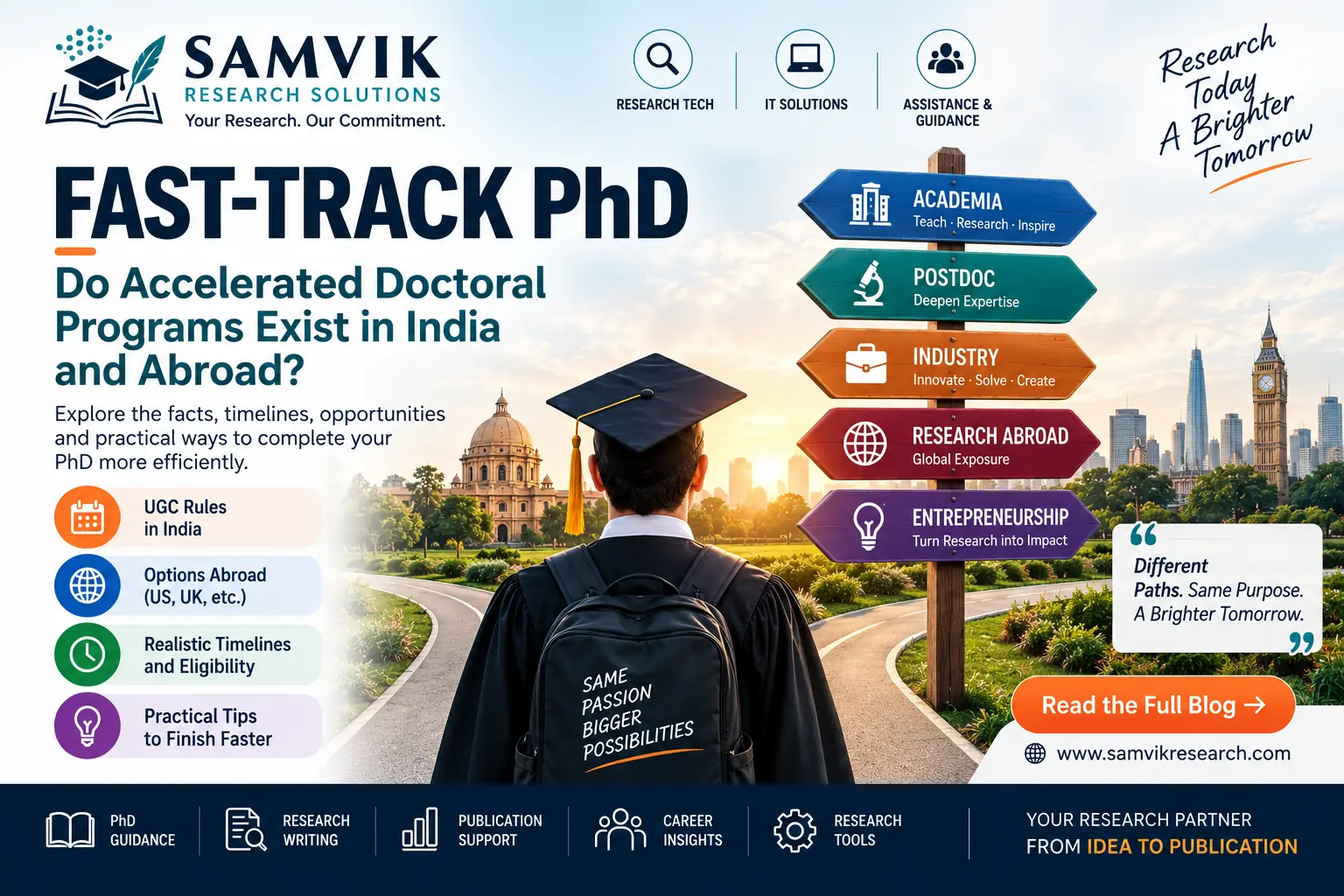
Every Indian PhD scholar knows this moment. Somewhere around year two, staring at a chapter that refuses to come together, you start wondering whether there is a faster way. Whether some scholars genuinely finish in three years while others take six. Whether the US or UK has accelerated programmes that offer a shorter route.
The answer is more nuanced than you might expect — and understanding it properly can help you plan your PhD timeline far more realistically than the vague “three to six years” most universities tell you.
2.5yrAICTE proposal (not yet implemented)
Quick Answer
In India
=
There is no legitimate fast-track PhD within India's UGC-regulated system. Under UGC Regulations 2022, the minimum duration of a PhD programme is three years, including coursework.
Abroad
=
Accelerated professional doctoral programmes exist but are fundamentally different from research PhDs and must be evaluated carefully for recognition in India.
What UGC Regulations 2022 Actually Say About Duration
The legal minimum: Under UGC Regulations 2022, the minimum duration of a PhD programme is three years, including coursework. This applies across all UGC-regulated universities. No institution can award a research PhD in less than three years and remain compliant with national regulations.
The duration is counted from the date of admission, though scholars should check their specific university's regulations regarding registration milestones — these vary between institutions. Women scholars and persons with disability above 40% are entitled to extensions of up to two additional years beyond the standard maximum duration under UGC provisions.
Part-time PhD programmes are permitted subject to UGC and institutional regulations. The applicable duration and requirements may vary by university — confirm the minimum and maximum duration directly with your institution before registering.
PhD Duration at a Glance
INDIA · UGC REGULATED
Research PhD
- Minimum 3 years including coursework
- Maximum 6 years
- Counted from date of admission
INDIA · PROPOSAL ONLY
AICTE 2.5-Year Pathway
- Proposed for technical disciplines only
- Not yet implemented
Not a current option
UNITED KINGDOM
Full-Time Research PhD
- Typically 3 to 4 years
- Already shorter than Indian maximum
- Good option for strong researchers
UNITED STATES
Research PhD
- Often 4 to 7 years including coursework
- No fast-track research PhD in most disciplines
US / UK ONLINE
Professional Doctorate
- DBA · EdD · DNP — can be shorter
- Different from a research PhD
- Verify India recognition before enrolling
Can You Complete a PhD in India in 3 Years?
Technically yes. Realistically — for most scholars — it is challenging but not impossible with the right conditions in place from day one.
The three-year minimum assumes coursework, research gap identification, data collection, analysis, writing, publication requirements, and thesis submission all progress efficiently and in parallel. Several factors commonly push timelines beyond three years.
Publication pressure matters: While UGC Regulations do not impose a universal requirement for Scopus publication before thesis submission, many universities have their own publication or research-output requirements. The peer-review and publication process can take several months and in some cases considerably longer — always check your university's current PhD ordinance.
In some institutions, supervisors manage multiple research scholars alongside teaching, administrative, and research responsibilities. Delays in feedback and revision cycles are common and can affect the overall timeline in ways that are difficult to anticipate at the start of a PhD. Many scholars take longer than the minimum duration simply because of these structural realities — not because of personal shortcomings.
The AICTE 2.5-Year Proposal — What Is Actually Being Discussed
Proposal Only — Not Implemented
Reports indicate that a task force has recommended a pathway that could allow eligible PhD scholars in engineering and technical disciplines to submit their thesis after 2.5 years under specified conditions. This should not be understood as an implemented national fast-track PhD rule. It is a proposal and a recommendation — not a notified regulation. Until formally approved and notified by the relevant authority, it does not create any current fast-track pathway for enrolled scholars.
Fast-Track Programmes Abroad — What Actually Exists
United Kingdom
The UK PhD is typically three to four years for a full-time research degree — already shorter than the Indian maximum. For Indian scholars with strong prior research experience and existing publications, a UK PhD can realistically be completed closer to the three-year mark. Some UK universities also offer PhD by Published Works pathways that can accelerate timelines for researchers with a significant prior publication record.
United States
Research-based PhDs in the US typically take four to seven years — longer than India in most cases because of extensive coursework requirements in the early years. Some accelerated professional doctoral programmes may offer shorter completion pathways depending on prior qualifications and credit transfers. However, these are fundamentally different from traditional research PhDs and must be evaluated separately for academic recognition and career relevance.
Critical warning on foreign degrees: Recognition of a foreign doctoral degree in India depends on the awarding institution, programme mode, degree structure, and the requirements of the relevant Indian authority or employer. Never assume a professional doctorate (DBA, EdD, DNP) from an online US university will be recognised for UGC-regulated faculty appointments in India. Verify before enrolling.
How to Actually Finish Faster — 5 Practical Strategies
1
Choose a narrow research question from day one
Broad or repeatedly changed research objectives are the single most common cause of timeline extension. Major changes in research design or scope can cost an entire year. Narrow scope, clear gap, specific context — from day one.
2
Start writing earlier than feels comfortable
Do not wait until data collection is finished to begin writing. Literature review and methodology chapters can be developed in parallel with fieldwork. Scholars who write continuously finish significantly faster than those who save all writing for the end.
3
Build your publication strategy in parallel
Treat publication as a parallel process, not a post-thesis task. Submitting a paper from your literature review or methodology chapter while fieldwork is still underway consistently reduces the total PhD timeline for scholars who do it well.
4
Structure your guide relationship proactively
Schedule regular, specific check-ins with defined deliverables. Send short progress updates regularly even when nothing dramatic has happened. Shorter, more frequent feedback cycles accumulate into significantly faster overall progress.
5
Map your institutional milestones from day one
Every Indian university has formal milestones — RDC, pre-submission seminar, synopsis submission, anti-plagiarism report. Map them all out at the start and plan your research around them, not after them.
Key Takeaways
- Under UGC Regulations 2022, the minimum PhD duration in India is 3 years including coursework; the maximum is 6 years.
- The AICTE 2.5-year pathway is a proposal only — not an implemented option for enrolled scholars.
- A UK PhD (3–4 years) is often the realistic “faster” route abroad; US research PhDs typically run 4–7 years.
- Professional doctorates (DBA, EdD, DNP) are not research PhDs — verify Indian recognition before enrolling in one.
- Finishing close to 3 years requires a narrow research question, early writing, parallel publication, and proactive milestone planning — not shortcuts.
Frequently Asked Questions
Can I do a PhD in India in 2 years?▾
No. Under UGC Regulations 2022, the minimum duration is three years including coursework. Any institution offering a research PhD in less than three years is not compliant with national regulations. If you encounter such claims, treat them as a serious red flag.
What is the minimum PhD duration in India in 2026?▾
Under UGC Regulations 2022, the minimum duration of a PhD programme is three years including coursework, counted from the date of admission. The maximum is six years for most scholars, with extensions permitted in specific circumstances. Always verify with your specific institution as implementation details vary.
What is the AICTE 2.5-year PhD proposal?▾
A task force has reportedly recommended a pathway that could allow eligible engineering and technical PhD scholars to submit their thesis after 2.5 years under specified conditions. This is a proposal, not an implemented national rule. Until formally notified by the relevant authority, it does not create any current fast-track option for enrolled scholars.
Do fast-track professional doctorates from the US count in India?▾
Recognition of a foreign doctoral degree in India depends on the awarding institution, programme mode, degree structure, and the requirements of the relevant Indian authority or employer. Never assume automatic recognition. Verify with UGC and your target institution before enrolling in any foreign doctoral programme.
What is the fastest a PhD can realistically be completed in India?▾
Three years from the date of admission, for full-time scholars who have a well-defined, narrow research topic from the start, maintain consistent guide engagement, meet publication requirements efficiently, start writing early, and avoid major revisions at synopsis or pre-submission stages. This is achievable but requires deliberate planning from day one.
Is a part-time PhD slower than full-time in India?▾
Part-time PhD programmes are permitted under UGC and institutional regulations, but the applicable duration and requirements vary by university. Working scholars typically face additional timeline pressures because of limited writing time alongside professional and personal commitments. Confirm the specific minimum and maximum duration with your institution before registering.
The Fastest PhD Is Not the One With the Shortest Timeline
It is the one with the fewest avoidable delays. At SAMVIK, we believe completing a PhD faster should never mean compromising research quality. From research planning and methodology to literature management, academic writing, publication strategy, and responsible use of ResearchTech tools — SAMVIK supports researchers in building more structured and efficient research workflows.
Talk to SAMVIK Research Team →
M
Dr. Mukul Misra
Senior Academician, Researcher & Research Administrator
This guide was prepared by the research experts at SAMVIK Research Solutions, a ResearchTech company building AI-powered tools and providing guidance for PhD admissions, research proposals, publications, journal selection, and academic research.
Related reading: PhD Admission in India 2026: Every Route In — How to Write a PhD Research Proposal That Gets Approved — Life After the PhD: Mapping Your Path