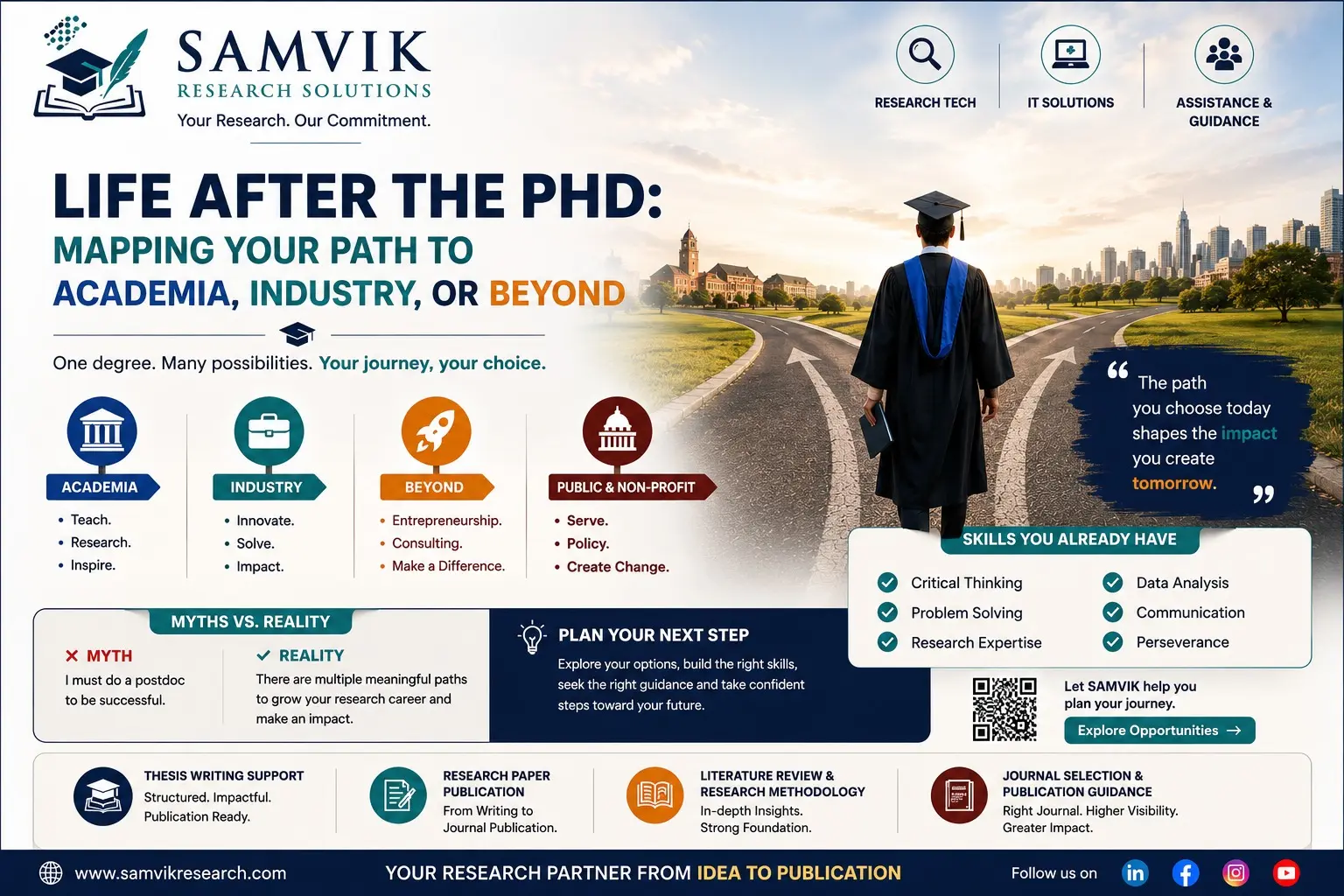
Finishing a thesis feels like a finish line. It is really a fork in the road — and the old rule that every PhD must follow “postdoc, then professor” no longer holds.
Years of literature review, methodology, experiments, revisions, and viva prep all lead to one new title: Dr. Then comes a much harder question — apply for a postdoc? Go for an assistant professorship? Move into corporate R&D? Become a research scientist? Look abroad? Or turn the research itself into a company? There isn’t one right answer, and recent commentary in Nature has pointed out that scientific careers rarely move in a straight line.
Most graduates end up choosing among three broad tracks. Each puts your doctoral training to a different use.
- PhD → Postdoc → Assistant Professor → Professor
- Publications, grants, and students drive progress
- PhD → Research Scientist → Senior Scientist → R&D Lead
- Products, technology, and applied innovation
- PhD → Government, Policy, Consulting, or a Startup
- Public impact or commercializing your research
Do You Actually Need a Postdoc?
The honest answer: it depends on where you’re headed. A postdoc builds new methods, international collaborations, and a stronger publication record — genuinely useful if academia or advanced R&D is the goal.
Want a stronger independent research profile
Want to become a professor, need a stronger independent research profile, or want international exposure and specialized training.
In India, structured options continue to grow: the government’s Common Fellowship Portal consolidates doctoral and postdoctoral funding across departments, and the National Post-Doctoral Fellowship supports early-career researchers directly.
Three Tracks, Side by Side
| Track | Best For | Core Focus |
|---|---|---|
| Academia | Teaching + independent research | Publications, grants, students |
| Industry R&D | Applied problem-solving | Products, technology, innovation |
| Government | Public-interest research | National programs, policy |
| Entrepreneurship | Commercializing research | Innovation + business building |
🎓 The Academic Route
A simplified path looks like: PhD → postdoc or equivalent research experience → assistant professor → associate professor → professor. But competition is intense, and a PhD alone rarely carries a candidate through it. You’ll also typically need:
Some researchers move straight from a PhD into a faculty post; others build their profile through one or more postdoctoral stints first. Either way, start building your research identity, publication record, and teaching experience before your viva.
🔬 The Industry Route
PhD holders are valued for solving ambiguous, hard problems — but industry doesn’t read a CV the way a university does. A publication list alone isn’t enough; you need to translate it into outcomes.
| Academic Language | Industry Language |
|---|---|
| Published 5 papers | Delivered research outcomes |
| Developed a methodology | Designed and implemented a solution |
| Presented at conferences | Communicated findings to stakeholders |
This doesn’t mean publications stop mattering — research experience needs to be translated into business and technical value. Sectors actively hiring PhD-trained researchers include biotech, pharma, AI and machine learning, data science, semiconductors, energy, EVs, healthcare, materials science, and scientific software.
Not sure which track fits your research?
Talk to a SAMVIK research mentor about your options.
🧪 Research Scientist: A Middle Ground
For scholars who love research but aren’t drawn to a traditional university career, a research scientist role blends depth, technology, and practical impact — working on new technologies, algorithms, scientific modeling, or applied research inside a company or institute. This path is becoming more relevant as AI reshapes science itself: Stanford’s 2026 AI Index reports AI-related publications in the natural sciences reached roughly 80,000 in 2025, even as leading AI systems still fall well short of PhD-level experts on complex, end-to-end research tasks. The opportunity this creates is straightforward — tomorrow’s researcher may not need to outcompete AI, just learn to work alongside it.
🚀 Government, Policy & Entrepreneurship
Public research roles — in national laboratories, scientific agencies, funding bodies, and think tanks — suit those who want their work to feed directly into policy or large-scale national programs. Meanwhile, doctoral research can become a company: Research Problem → Innovation → Prototype → Validation → Intellectual Property → Startup. This shows up especially in AI, biotech, healthcare, renewable energy, and EdTech. Not everyone should found a company — but research itself creates commercial and social value worth recognizing, not just a line on a CV.
What to Do in Your Final PhD Year
One of the biggest mistakes is waiting until after the degree to think about the next step. Ideally, planning starts 6–12 months before submission, across a few key areas:
| Area | What to Build |
|---|---|
| Research | A clear, defensible specialization |
| Publications | Quality over sheer volume |
| Network | Faculty, peer researchers, industry contacts |
| CV | Separate academic and industry versions |
| Online presence | ORCID, Google Scholar, LinkedIn |
| Communication | Explaining your work in plain language |
Which Path Actually Fits You?
Work through these honestly before choosing a direction:
| If You’re Drawn To… | Consider… |
|---|---|
| Teaching and research | Professor / Academia |
| Deep scientific inquiry | Postdoc / Research Scientist |
| Technology and application | Industry R&D |
| Public impact | Government Research / Policy |
| Business and innovation | Entrepreneurship |
| Data and technology | Data Science / AI Research |
Myth vs. Reality
| Claim | |
|---|---|
| ✗ Myth | You must do a postdoc after a PhD. |
| ✓ Reality | Valuable for many paths, but not the only route. |
| ✗ Myth | More papers always means a better career. |
| ✓ Reality | Quality, impact, and communication matter just as much. |
| ✗ Myth | Industry means giving up research. |
| ✓ Reality | Many industry roles involve serious experimentation and innovation. |
| ✓ Fact | AI is reshaping research workflows — but current benchmarks show human researchers remain essential for complex reasoning and validation. |
Your 5-Step Roadmap
Quick Answers
Your PhD is the achievement. Your research career is what comes next.
Talk to a SAMVIK mentor to map the path — academia, industry, or beyond — that fits your skills, interests, and definition of impact.
Plan Your Next Step →