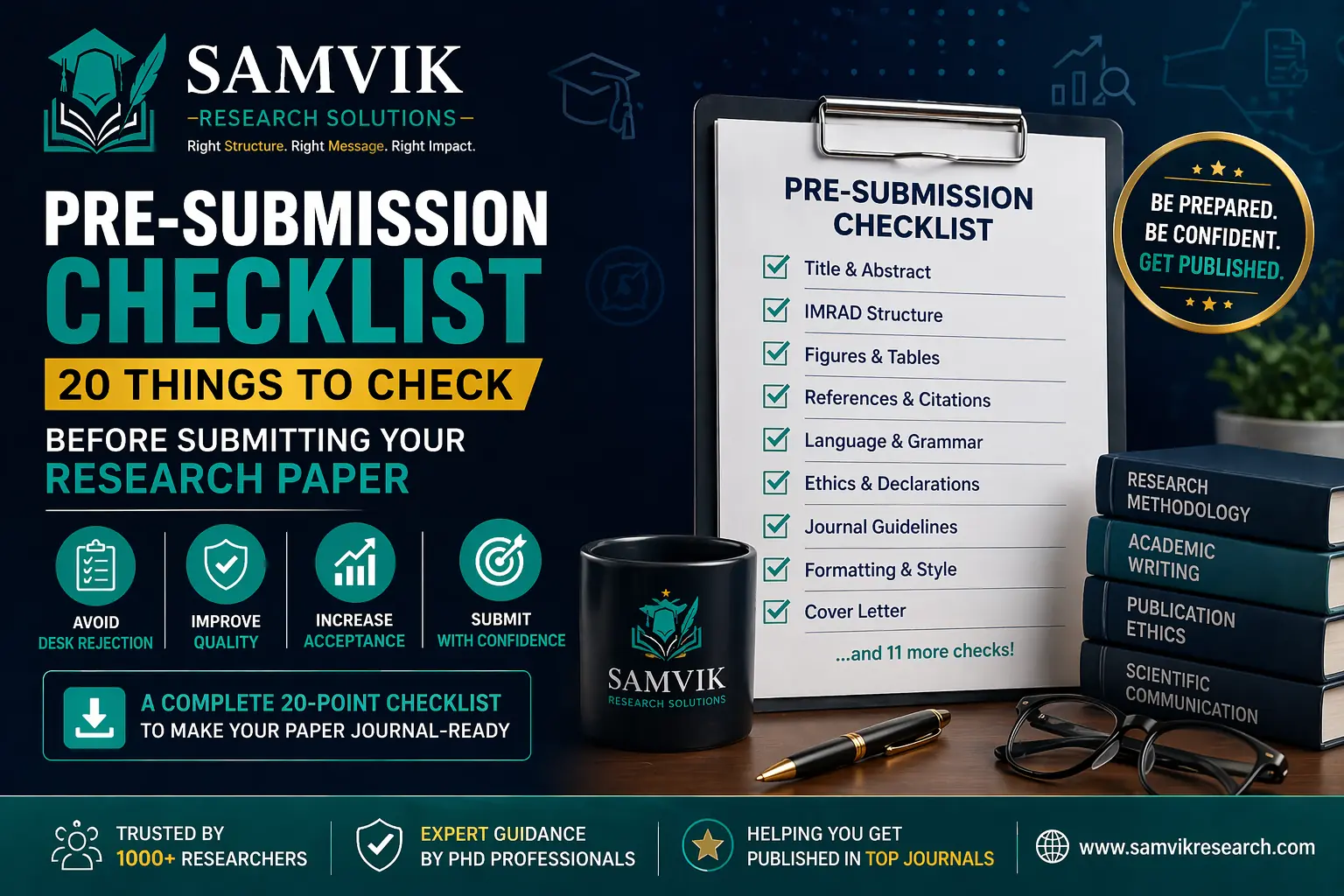

You've spent months — sometimes years — on your research. The data is strong. The methodology is sound. You're ready to submit.
But here's what most PhD programs don't teach you: around 50% of manuscripts are rejected at the editor's desk before a single reviewer reads them. And in almost every case, the reason isn't the quality of the research. It's something on this checklist.
Why Papers Get Desk Rejected — Before You See the Checklist
Before the 20-point list, understand what's actually causing desk rejections at journals right now. Each of these is fully fixable before you submit.
Cause 1 — Wrong journal scopeSubmitting a clinical paper to a basic science journal, or a social science study to a STEM-focused outlet. Editors reject scope mismatches in minutes. Always read recent published articles in your target journal before submitting.Cause 2 — Formatting & word limit violationsMany submission portals automatically flag overlength manuscripts. Some journals auto-reject if the abstract format (structured vs unstructured) doesn't match their requirements. These are system-level blocks — not editorial decisions.Cause 3 — Missing ethics or declarationsNo ethics approval statement. No conflict of interest declaration. No CRediT author contributions. These are now mandatory at most major publishers and trigger immediate rejection when absent.Cause 4 — Weak language & structureTense inconsistency, Results and Discussion mixed together, unclear research gap — editors experience these as "lack of clarity." For a full structural fix, see the IMRAD format guide before working through this checklist.Real Example — A paper rejected three times for one missing sentenceA researcher came to us after three consecutive desk rejections from different journals. The study was genuinely strong — two years of fieldwork, robust methodology, clear findings. Every rejection said the same thing: "Does not meet submission requirements." When we reviewed the manuscript, we found it within 10 minutes. The ethics approval had been obtained and documented correctly — but it had never been included in the manuscript itself. A single statement, a single line, missing across three submissions. That's item 14 on this checklist. Three rejections. Three months each. For one sentence that took two minutes to write.5 Categories · 20 CheckpointsA · Language & Grammar (Checks 1–4)
These four checks can prevent months of delay. Language issues are the most frequently cited reason for reviewer criticism — and the most fixable.
1. Verb tense consistency
Each section requires a specific tense. Methods = past. Introduction facts = present. Results figures = present. Wrong tense is the single most flagged language issue by reviewers. See the section-by-section tense guide.
How to checkRead each section in isolation and check: does every verb match the rule for this section?2. Active vs passive voice
Many journals now prefer active voice in Methods and Discussion. Passive is acceptable in Results. Know your target journal's preference — it's often stated in their author guidelines.
How to checkSearch for "was conducted," "were observed" — flag each and assess whether active voice would be stronger.3. British vs American spelling
Mixing "analyse" with "behavior" signals inconsistency. Check your target journal's language preference — usually stated in their author guidelines.
How to checkSet your spell-checker's language before your final read-through.4. Abbreviations defined on first use
Every abbreviation must be defined in the abstract AND again in the main text on first use. Don't assume readers know your field-specific acronyms.
How to checkSearch for all uppercase abbreviations — verify each has a full definition the first time it appears.B · Structure & Content (Checks 5–9)
Structure issues are invisible to the author but immediately obvious to reviewers. If your IMRAD structure is weak, fix it before running this checklist — see the IMRAD format guide.
5. Title is specific and searchable
Your title should contain your main variable, population, and study design in under 15 words. Vague titles rank poorly in Scopus, PubMed, and Google Scholar — making your paper invisible to the researchers most likely to cite it.
How to checkGoogle your own title. If nothing similar appears, it may be too vague.6. Abstract format & within word limit
Structured vs unstructured — wrong format for that journal is an instant desk rejection. Most limits are 150–300 words. Some portals block submissions that exceed this before an editor even sees them.
How to checkConfirm: does the journal require structured (Background/Methods/Results/Conclusion) or unstructured?7. Research gap explicitly stated
Your Introduction must build to a clear, specific gap in existing literature. If a reviewer can't identify why this study was needed in two sentences — the gap isn't explicit enough.
How to checkRead only your last 3 Introduction paragraphs. Is the gap immediately clear?8. Results and Discussion cleanly separated
This is the most common structural error journals see. Results = what the data showed. Discussion = what it means. If a sentence in your Results contains "suggests" or "indicates" — move it to Discussion immediately.
How to checkScan every Results sentence for interpretive language. Zero tolerance here.9. Conclusion answers the research question
Place your Introduction's final research objective sentence beside your Conclusion's final paragraph. They should feel like a matched question and answer. If they don't, there's a structural gap reviewers will find.
How to checkPlace both sentences side by side and compare directly.Quick Structural TipPrint your paper and read it backwards — section by section (Conclusion → Discussion → Results → Methods → Introduction). This catches structural drift your brain automatically skips when reading forward.C · References & Citations (Checks 10–13)
Reference errors are tedious but completely avoidable. These four checks are non-negotiable before any submission.
10. Reference format matches journal style
APA, Vancouver, Harvard, AMA, Chicago — each journal specifies one. Using the wrong format signals to editors you haven't read their guidelines. Check 3 references manually against a published article in that same journal.
How to checkUse Zotero or Mendeley with the journal's citation style loaded before final export.11. Every in-text citation has a list entry
Orphaned citations (in text, missing from list) and ghost references (in list, never cited) are both errors reviewers flag. After multiple drafts, these are easy to miss.
How to checkSort your reference list alphabetically. Cross-check every in-text citation manually.12. DOIs present and verified
Many journals now require DOIs for all references that have them. A broken DOI is a credibility red flag. Verify at doi.org — most reference managers can auto-populate missing ones.
How to checkRun your list through Zotero or Mendeley to auto-check and fill missing DOIs.13. Recent literature represented
If most references are 10+ years old, reviewers will question your current command of the field. Aim for at least 30% of citations from the last 5 years, especially in your Discussion.
How to checkFilter by year. Run a fresh database search if recent literature is thin.D · Ethics & Declarations (Checks 14–16)
Missing declarations are an increasingly common reason for instant desk rejection. This is the category most researchers underestimate — until it costs them.
14. Ethics approval statement
Any study involving human participants, animals, or patient data must include the ethics committee name and approval number in the manuscript. Getting the approval but not including it — as in the real example above — is still a rejection.
How to checkCheck the journal's exact required wording in their author guidelines. Copy it precisely.15. Conflict of interest declaration
All authors must declare conflicts of interest. "None declared" is valid and required. Its absence halts manuscript processing immediately at most major publishers.
How to checkEven if there is no conflict, the statement must be present explicitly in the manuscript.16. Author contributions statement (CRediT)
Most Elsevier, Springer, and Wiley journals now require a CRediT statement specifying each author's role. Missing this is flagged by automated submission systems at major publishers.
How to checkVisit credit.niso.org for all 14 CRediT roles. Assign each co-author before submission.E · Formatting & Technical (Checks 17–20)
Formatting errors are the quickest to fix and the easiest to prevent. These four checks take under 20 minutes and stop automated rejection.
17. Word count within journal limit
Most original articles have limits of 3,000–8,000 words. Some portals automatically reject overlength submissions before an editor sees them. Check whether the abstract, references, and captions count toward the limit — this varies.
How to checkVerify the word count policy in author guidelines, not just the number.18. Figure resolution is 300 DPI minimum
Figures must meet the journal's resolution requirement (typically 300 DPI for print). Tables must be editable — not images. Colour figures may carry additional fees; check before submitting.
How to checkZoom each figure to 100% on screen. If it pixelates, resolution is insufficient.19. Supplementary files labelled & referenced
Every supplementary file must be referenced in the main text ("See Supplementary Table S1") and given a descriptive title in the portal. Unreferenced or unlabelled files are flagged at most journals.
How to checkSearch main text for every S1, S2 reference and verify the file exists and is named.20. Cover letter tailored to this journal
Name the journal. Explain in 2–3 sentences why this work fits their scope. State it is not under review elsewhere. Highlight the key contribution. A generic cover letter that could go anywhere is a missed opportunity — and some editors notice.
How to checkIf your letter contains no journal-specific language — rewrite it before submission.Common Research Paper Submission Mistakes — Ranked by Risk
If you're short on time, start with the items marked Desk Rejection. These are direct causes of desk rejection — not just revision risk.
| # | Checkpoint | Category | If Missed |
|---|---|---|---|
| 1 | Verb tense consistency | Language | Desk Rejection |
| 6 | Abstract format & word limit | Structure | Desk Rejection |
| 10 | Reference style | References | Desk Rejection |
| 14 | Ethics approval statement | Ethics | Desk Rejection |
| 15 | Conflict of interest | Ethics | Desk Rejection |
| 17 | Word count limit | Formatting | Desk Rejection |
| 8 | Results vs Discussion mix-up | Structure | Major Revision |
| 13 | Recent literature included | References | Major Revision |
| 18 | Figure resolution 300 DPI | Formatting | Major Revision |
| 20 | Tailored cover letter | Formatting | Missed Opportunity |
Related Reading
IMRAD Format Explained — The Exact Structure Journals Expect
UGC CARE Discontinued — Choosing Journals After February 2025
Frequently Asked Questions
What is a desk rejection and how do I avoid it?
A desk rejection happens when an editor rejects your manuscript without sending it for peer review — usually because it falls outside the journal's scope, exceeds the word limit, has missing declarations, or uses the wrong reference format. Working through this 20-point checklist before submission removes most desk rejection risk. See also the IMRAD format guide for structural issues.
What are the most common research paper submission mistakes?
The most common mistakes are: using the wrong reference format for the target journal, missing the conflict of interest declaration, exceeding the abstract word limit, mixing Results and Discussion content, not verifying DOIs, using inconsistent verb tense, and submitting a generic cover letter. All are fixable before submission — none require additional research.
How long before submission should I complete this checklist?
Ideally 48–72 hours before your intended submission date. This gives you time to fix what you find — particularly reference errors or formatting issues — without rushing. Don't run through it the night before.
Do I need ethics approval for a literature review or meta-analysis?
Generally no — secondary analyses of published data typically don't require ethics approval. If you're using unpublished datasets or patient-level data, check with your institution's ethics committee before submission.
Is a cover letter mandatory for journal submissions?
Most journals require or strongly recommend one. Even when optional, a well-written, journal-specific cover letter can influence which editor handles your paper and how it's initially framed — particularly at journals receiving high submission volumes.
Want a final review before you submit?SAMVIK Research Solutions reviews manuscripts against this exact checklist — language, structure, references, ethics, and formatting — so your paper reaches reviewers in the best possible shape. Request a review or explore our research paper publication service.