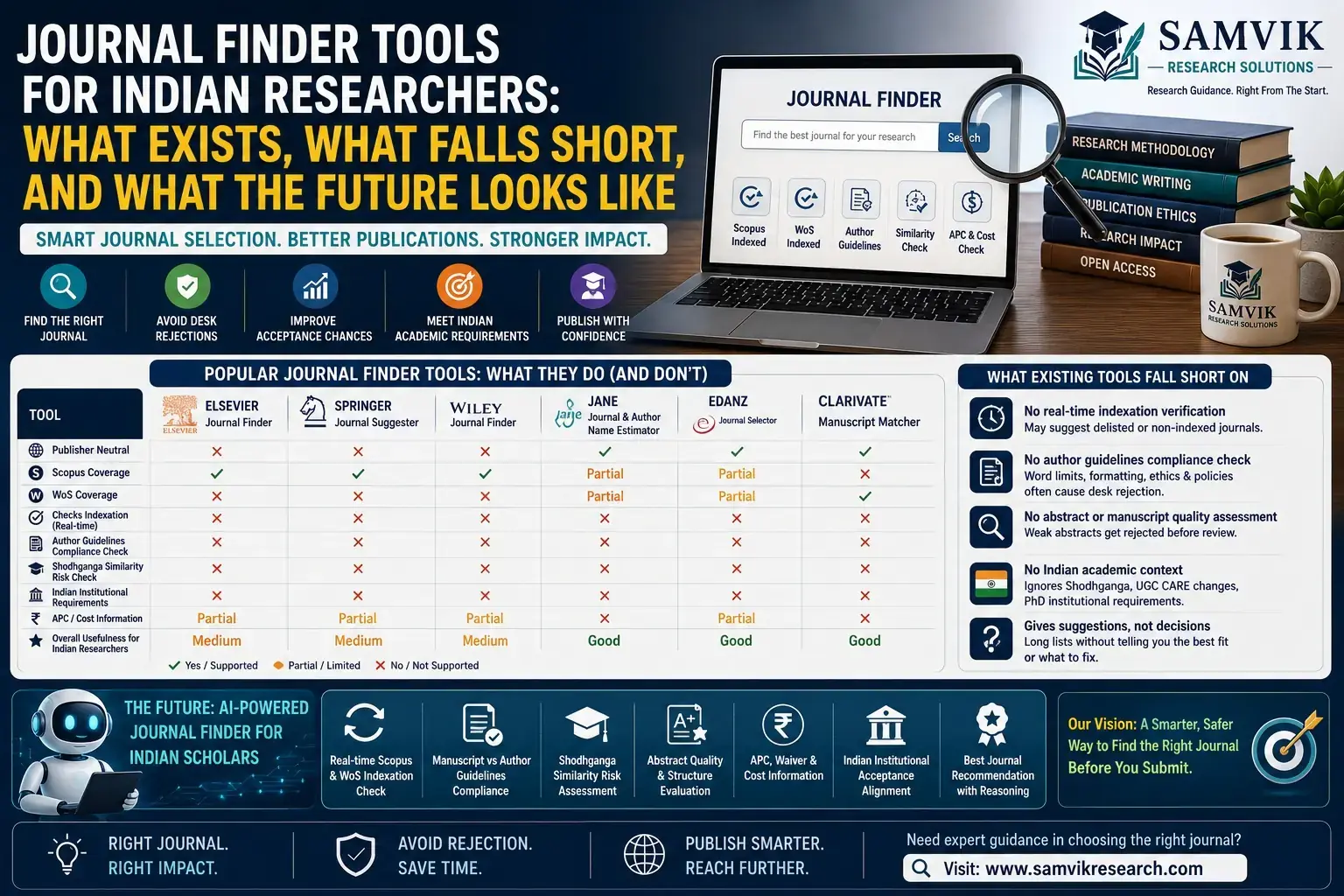

Choosing the wrong journal wastes months. You submit, wait three months, receive a desk rejection, and start again. Most of that waiting time is avoidable if you match your paper to the right journal before submitting — not after. Journal finder tools exist to solve this problem. But most of them solve only part of it.
Quick Answer — Best Free Journal Finder Tools in 2026Elsevier Finder=Best for Elsevier journals only. Free. Matches your abstract to the Elsevier catalogue.Springer Suggester=Best for Springer journals only. Free. Same catalogue restriction as Elsevier.Jane=Best for biomedical research. Free, publisher-neutral, matches PubMed-indexed journals. Limited use outside life sciences.Edanz Selector=Broadest multi-publisher coverage. Free basic version. No India-specific context.Clarivate Matcher=Best for Web of Science journals. Limited free access. Does not cover Scopus-only journals.Each of these tools has significant limitations. Most are restricted to their own publisher catalogues, none verify current Scopus or WoS indexation in real time, and none address India-specific challenges like Shodhganga similarity, UGC requirements, or post-UGC CARE journal selection. This guide tells you which tool to use for which situation — and what a genuinely useful journal finder for Indian scholars still needs to build.
Best Free Journal Finder Tools — At a Glance
Elsevier Journal Finder
Best for Elsevier journals only. Free. Matches your abstract to the Elsevier catalogue. It does not cover Springer, Wiley, or independent publishers, so you only ever see a slice of the journals available in your field.
Springer Journal Suggester & Wiley Journal Finder
Both are free and accurate within their own catalogues. Springer Suggester surfaces Springer journals; Wiley Finder uses keyword and abstract matching for Wiley titles. The same limitation applies to both — they are catalogue-restricted and will never suggest a journal from a competing publisher.
Jane (Journal/Author Name Estimator)
Best for biomedical research. Free, publisher-neutral, and matches against PubMed-indexed journals. Highly accurate for life sciences, medicine, nursing, and public health. Of limited use for engineering, management, social sciences, or humanities.
Edanz Journal Selector
Multi-publisher coverage with a free basic version — broader than publisher-specific tools. It lacks Indian context, however: no UGC CARE awareness, no Shodhganga guidance, and no institutional requirement matching.
Clarivate Manuscript Matcher
Best for Web of Science journals. Limited free access. Matches your title and abstract against WoS-indexed journals across SCI, SSCI, AHCI, and ESCI. Strong for WoS coverage, but it does not address Scopus-only journals — which represent a significant portion of the journals Indian PhD scholars legitimately target.
Journal Finder Tools Compared
No single tool reliably covers all Scopus-indexed journals across every discipline in a publisher-neutral way. The practical approach for Indian scholars is to use a tool for initial discovery, then verify manually at the official source.| Tool | Coverage | Publisher-neutral | Verifies indexation | Indian context |
|---|---|---|---|---|
| Elsevier Finder | Elsevier only | ❌ | ❌ | ❌ |
| Springer Suggester | Springer only | ❌ | ❌ | ❌ |
| Wiley Finder | Wiley only | ❌ | ❌ | ❌ |
| Jane | PubMed / biomedical | ✅ | ⚠️ PubMed only | ❌ |
| Edanz Selector | Multi-publisher | ✅ | ❌ | ❌ |
| Clarivate Matcher | Web of Science | ✅ within WoS | ⚠️ WoS only | ❌ |
Which Tool to Use for Your Situation
Biomedical, nursing, or public health? Use Jane first. It is free, publisher-neutral, and built specifically for PubMed-indexed journals.
Set on an Elsevier journal? Use Elsevier Journal Finder. It is fast and accurate within that catalogue.
Targeting WoS for fellowship or promotion? Use Clarivate Manuscript Matcher as a starting point, then verify each suggestion at mjl.clarivate.com.
Indian PhD scholar targeting Scopus for thesis submission? Start with Edanz for a broad list, then manually verify every suggestion at scopus.com/sources — and independently check whether the suggested journals are accepted under your institution's current PhD regulations.
How to Find a Scopus Journal for Your Research Paper
No single journal finder tool reliably surfaces Scopus-indexed journals across all disciplines in a publisher-neutral way. The most practical approach for Indian scholars is to use a tool for initial discovery, then verify manually.
Use Edanz or Elsevier Finder to generate an initial list of journals that match your topic and scope. Then for each suggestion, go to scopus.com/sources and search the journal by title or ISSN. Check that the status shows Active — not Discontinued or Temporarily Not Available. A journal that does not appear here is not currently Scopus indexed, regardless of what any finder tool says.
A scope match is not the same as an intellectual fit. After a tool suggests a journal, read its Aims & Scope page and three to four recent papers. If your paper does not extend the conversation those papers are having, the match is surface-level — a keyword overlap, not a genuine fit.How to Find a WoS Journal for Publication
For Web of Science journal discovery, Clarivate Manuscript Matcher is the most purpose-built tool. Paste your abstract and it will match against WoS-indexed journals across SCI, SSCI, AHCI, and ESCI.
Verify each suggestion at mjl.clarivate.com. Check whether the journal is SCI, SSCI, or ESCI — this distinction matters for Indian faculty API scoring and fellowship applications. Some Indian institutions accept ESCI publications for API credit; others do not. Confirm your institution's position before targeting an ESCI journal specifically.
Why Journal Finder Tools Fail Indian Researchers
Every existing journal finder tool leaves the same gaps. Understanding them helps you compensate manually until better tools exist.
They do not verify current indexation
Tools use cached databases. A journal listed as indexed in a tool's database may have been delisted from Scopus or WoS since the last update. A scholar who submits to a delisted journal on a tool's recommendation has no recourse.
✅ Fix: Always verify at the official source on the day of submission — not the day you started writing.They are catalogue- or field-restricted
Publisher-specific tools cover only their own catalogues. Jane covers biomedical journals. Neither gives you a complete picture of the journals available in your specific discipline across all publishers.
✅ Fix: Cross-check at least two tools, and treat any single tool's list as partial by default.They do not check author guidelines
A scope match is not submission readiness. A journal finder that does not compare your manuscript's word count, reference style, and section structure against the target journal's actual guidelines is missing one of the leading causes of desk rejection.
✅ Fix: Run your manuscript against the journal's guidelines manually — see our pre-submission checklist.They have no Indian context
None of the available tools know what Shodhganga is. None address the post-UGC CARE publication landscape. None tell you whether a suggested journal will be accepted under your institution's current PhD regulations, or whether your paper — derived from a Shodhganga-indexed thesis — will trigger iThenticate similarity flags.
✅ Fix: Read our guide on the UGC CARE discontinuation and confirm acceptance with your department before you submit.They give suggestions, not decisions
A list of twenty potential journals does not tell you which one to choose, why, or what to fix in your manuscript before submitting to any of them.
Can AI Choose the Right Journal for Your Paper?
This question is being searched by increasing numbers of researchers in 2026 — and the honest answer is: not yet, but closer than most researchers think.
ChatGPT and general AI assistants can suggest journals based on topic matching, but they cannot verify current Scopus or WoS indexation, access real-time journal metadata, or check author-guideline compliance. Using ChatGPT for journal selection without independent verification is as unreliable as any other unverified source.
⚠️ The gap that matters is not AI capability — it is AI built specifically for academic publishing workflows, with access to real-time journal databases, current author guidelines, and India-specific regulatory context. That specific combination does not yet exist in a publicly available tool.SAMVIK · Coming SoonWhat a journal finder built for Indian researchers needs to do
The market gap is clear. A tool that genuinely serves Indian PhD scholars would need seven capabilities that no current tool provides together:
Real-time indexation verification — current Scopus and WoS status on the day of query, not from a cached database
Author-guideline compliance checking — word count, reference style, section structure, and ethics requirements against the journal's current rules
Abstract quality scoring — a clear gap, stated method, specific finding, and field implication, the four elements whose absence causes most desk rejections
Indian institutional requirement awareness — which journals satisfy post-UGC CARE rules and are accepted by IITs, central, state, and deemed universities
Shodhganga similarity risk detection — flagging sections likely to trigger iThenticate before submission
APC transparency and waiver guidance — realistic total publication cost
One specific recommendation, not a ranked list — this journal, for these reasons, with these changes
Journal Selection Workflow — Before You Submit
A reliable journal selection process for Indian scholars follows this sequence:
Use a journal finder tool to generate initial suggestions based on topic and scope.
Verify each suggestion manually at scopus.com/sources or mjl.clarivate.com for current indexation status.
Read three to four recent papers from the shortlisted journal to confirm genuine scope fit.
Check author guidelines and ensure your manuscript complies with word count, reference style, and section requirements.
Run a similarity check to identify any Shodhganga-related content that needs to be rewritten.
Write a journal-specific cover letter referencing recent papers from that journal, then submit.
Frequently Asked Questions
Is Elsevier Journal Finder free?▾Yes. Elsevier Journal Finder is completely free at journalfinder.elsevier.com. You paste your abstract and it suggests journals from Elsevier's catalogue. The limitation is that it only covers Elsevier publications — it will not suggest journals from Wiley, Springer, Taylor & Francis, or any independent publisher.Which journal finder is best for Scopus journals?▾No single tool reliably covers all Scopus-indexed journals across all disciplines. Edanz Journal Selector has the broadest multi-publisher coverage for general use. For any tool's suggestions, always verify current Scopus indexation independently at scopus.com/sources.Can ChatGPT find journals for research papers?▾ChatGPT can suggest journals based on topic matching but cannot verify current Scopus or WoS indexation, access live journal databases, or check author-guideline compliance. Any ChatGPT journal suggestion should be independently verified at official sources before submission.Are journal finder tools accurate?▾For topic-to-scope matching, they are reasonably accurate. For indexation status, compliance checking, abstract quality evaluation, and India-specific requirements — they are not. Use finder tools for initial discovery, then verify every recommendation manually.How do I verify journal indexing independently?▾For Scopus, go to scopus.com/sources and search by journal title or ISSN. For WoS, go to mjl.clarivate.com. For open access verification, check doaj.org. For ISSN validity, check portal.issn.org. Always verify on the day you plan to submit — not when you started writing.Not Sure Which Journal Is Right for Your Paper?
SAMVIK Research Solutions works with Indian PhD scholars on exactly this workflow — journal verification, scope alignment assessment, and pre-submission manuscript review.
Talk to a SAMVIK Expert →MDr. Mukul MisraSenior Academician, Researcher & Research AdministratorSAMVIK Research Solutions provides research writing guidance and publication support for Indian PhD scholars — including journal selection, indexation verification, and pre-submission manuscript review.Related reading: Scopus vs WoS vs UGC CARE — Which Journal Should You Target · How to Avoid Desk Rejection in Journal Submission · Pre-Submission Checklist for Research Papers · What Is a Predatory Journal and How to Identify One