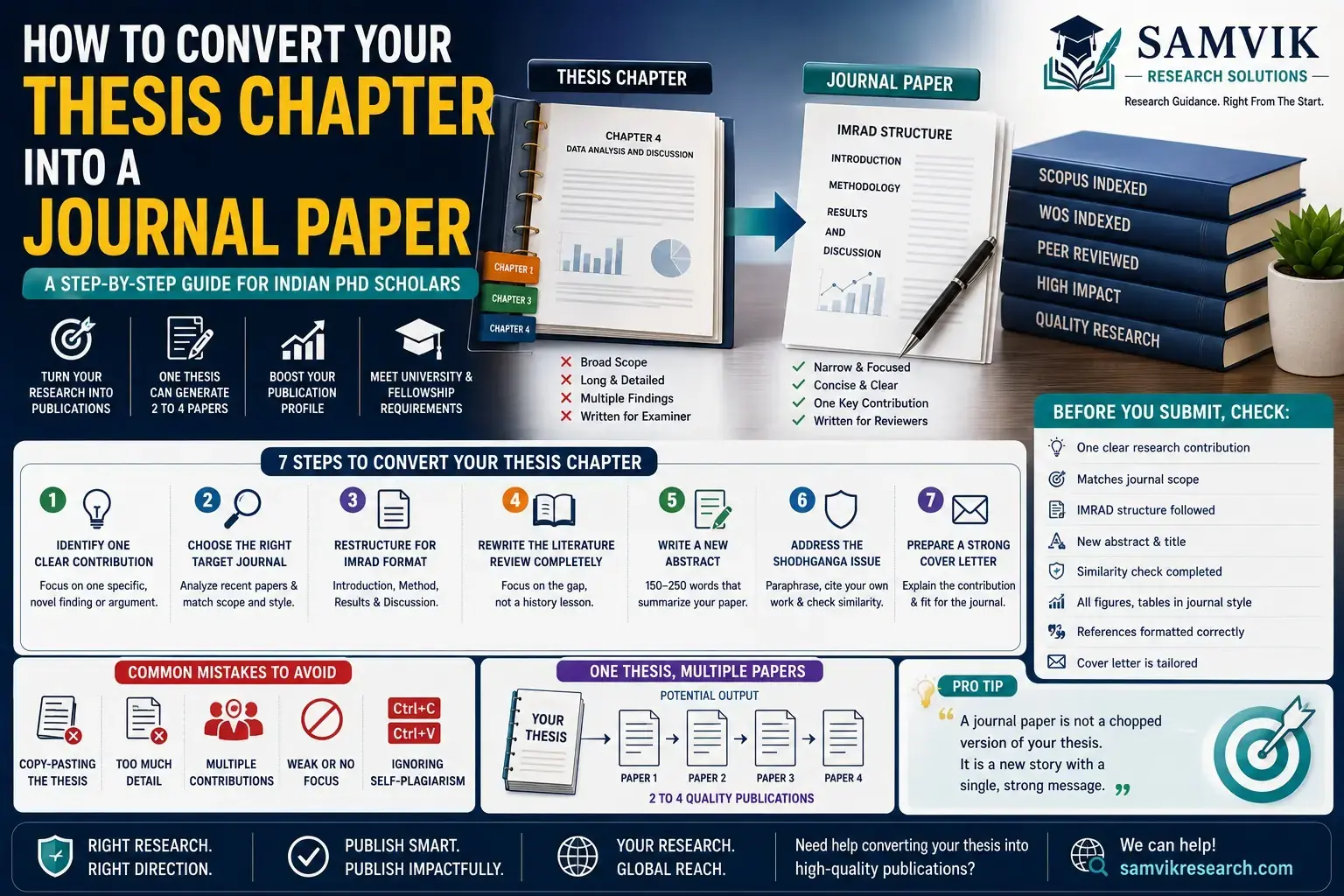

Most Indian PhD scholars are sitting on months of original research already written inside their thesis. But submitting a thesis chapter directly to a journal without conversion almost always results in desk rejection — not because the research is weak, but because a thesis chapter and a journal paper are two completely different documents written for two different audiences.
Quick AnswerWhat it takes=Narrow scope to one clear contribution, restructure for IMRAD, rewrite the abstract and literature review from scratch, and fix the Shodhganga self-plagiarism issue before submitting.The payoff=Done correctly, one thesis can generate two to four Scopus or WoS publications.This guide gives you every step of the conversion process — including the India-specific Shodhganga plagiarism problem that most international guides never mention.
Thesis Chapter vs Journal Paper — Key Differences
A thesis chapter is written to show your examiner you have understood your field comprehensively. A journal paper is written to advance the field with one specific, original contribution.
| Factor | Thesis Chapter | Journal Paper |
|---|---|---|
| Length | 8,000–15,000 words | 5,000–8,000 words |
| Scope | Covers everything relevant | One focused argument, made well |
| Audience | Your examiner | Expert reviewers who know the field |
| Goal | Demonstrate comprehension | Show what is new |
Can a Thesis Be Published in a Scopus Journal?
Yes — but not by copy-pasting. Thesis-derived content submitted without conversion is too long, too broad, and will trigger iThenticate similarity flags if the thesis is indexed on Shodhganga.
When conversion is done properly — one focused contribution, IMRAD structure, rewritten literature review, fresh language throughout — thesis-derived research publishes successfully in Scopus and WoS indexed journals regularly. The conversion process is what separates a desk rejection from a peer review.
The 7-Step Thesis-to-Journal Conversion Process
Step 1 — Identify the One Contribution This Paper Will Make
Before changing a single word, answer this: what is the one thing this paper will contribute to the field? Not three things. One specific, defensible, novel contribution.
✅ Write it in one sentence: "This paper demonstrates [specific finding] in [specific context] using [specific method], which advances [specific aspect of the field] by [specific way]." If you cannot write that sentence, you have not yet identified the contribution — and everything else depends on it.Step 2 — Choose the Target Journal Before You Rewrite
This step comes before rewriting — not after. The journal you target determines word limit, reference style, structure, and the depth of literature engagement your paper needs.
✅ Fix: Read three to five recently published papers in your target journal. Your converted paper needs to feel like it belongs in their recent issues. Cite at least three papers from the target journal within your manuscript — editors notice this, and it signals genuine engagement rather than mass submission. Need help? See our guide to choosing the right journal.Step 3 — Restructure for IMRAD Format
Most thesis chapters follow a narrative structure. Most journal papers follow IMRAD — Introduction, Methodology, Results, Discussion.
Introduction opens with the research problem, narrows to the specific gap, and closes with a clear statement of your contribution. It is not a history of your field — it is an argument for why this paper needed to be written.
Methodology should be tighter than your thesis chapter. Focus on the specific design, sample, instrument, and analysis relevant to this paper's contribution only.
Results present only data that directly addresses your research question. Remove findings that belong to other parts of your thesis.
Discussion interprets your findings, connects them to existing literature, and explains what your contribution means for the field — not a summary of results.
Step 4 — Rewrite the Literature Review Completely
Do not paste your thesis literature review into your journal paper. Write a new one from scratch — typically 600 to 1,000 words — covering only directly relevant prior work and identifying the specific gap your paper addresses. Include at least three papers from your target journal. This signals to the editor that you understand where your paper fits in the conversation their journal is having.
Step 5 — Rewrite the Abstract Completely
Your thesis abstract summarises the entire thesis. Your journal abstract is a standalone 200–250 word document that must convince an editor in under two minutes that your paper is worth sending to peer review.
✅ Four-part structure: the research problem and gap, the method, your key finding, and the implication for the field. Write it fresh. Do not use any part of your thesis abstract.Step 6 — Avoid Self-Plagiarism From Your Thesis
This is the most India-specific step — and the one most commonly missed. When your thesis is submitted to Shodhganga, as required by most Indian universities, it becomes an indexed source in academic databases. iThenticate — the plagiarism detection system used by most Scopus-indexed journals — flags any paragraphs from your Shodhganga-indexed thesis that appear in your journal submission as similarity matches against your own prior work.
This means submitting thesis paragraphs directly to a journal triggers a similarity flag even though the work is entirely yours. Many Indian scholars receive desk rejections citing high similarity for exactly this reason.
✅ Fix: Rewrite every section in fresh language. Do not paraphrase sentence by sentence — restructure entire paragraphs so the argument is expressed differently, not just differently worded. Run a plagiarism check before submission and follow the similarity expectations of your target journal — most prefer low similarity scores with properly cited overlaps.Step 7 — Write a Journal-Specific Cover Letter
Write a cover letter that names the specific journal, references one or two recent papers it published that your work builds on, summarises your contribution in three sentences, and confirms the paper is not under simultaneous review elsewhere. This takes thirty minutes. Skipping it is one of the most avoidable desk rejection triggers.
Before and After — How to Frame Your Contribution
How you open your paper changes completely between formats.
📄 Thesis version: "The present study investigated various aspects of digital marketing adoption among small and medium enterprises in the Indian context with reference to multiple variables…"📰 Journal version: "This paper demonstrates that perceived ease of use — not cost — is the primary barrier to digital marketing adoption among micro-enterprises in Tier-2 Indian cities, challenging the dominant resource-constraint framework in SME digital adoption literature."The research is the same. One is descriptive. The other makes a claim. Journal papers need to make claims.
Thesis-to-Journal Conversion Checklist
📋Before You Submit
One clear, single contribution identified and written in one sentence.
Target journal selected and read before rewriting began.
Paper restructured to IMRAD format.
Literature review written fresh — not pasted from thesis.
At least three papers from the target journal cited in the manuscript.
Abstract rewritten from scratch in four-part structure.
All thesis-derived content rewritten in fresh language throughout.
Similarity check run against the target journal's expectations.
Journal-specific cover letter written — not a template.
Frequently Asked Questions
Can I publish my thesis chapter before submitting my thesis?▾Yes, in most cases. Many Indian universities encourage or require pre-thesis publication. Check your institution's specific PhD regulations — some require accepted papers before thesis submission, others allow concurrent timelines.Does Shodhganga count as prior publication?▾Shodhganga is a repository, not a journal. Your thesis deposited there is not considered a prior publication. However, it is indexed by iThenticate, which means reusing thesis paragraphs in journal submissions will trigger similarity flags. Rewrite the content properly and disclose the thesis origin to the journal.Can one thesis chapter become multiple papers?▾Yes — if the chapter contains genuinely distinct contributions. Each paper must stand alone as an independent, original contribution. They cannot share the same core finding with minor variations.How much similarity is acceptable for journals?▾Journals vary, but most prefer total similarity below 15 to 20 percent. What matters more is where the similarity appears — methods sections are less concerning than introduction or discussion sections. Follow the expectations of your specific target journal.Can I publish in a Scopus journal after thesis submission?▾Yes. Submitting your thesis does not prevent journal publication. Many scholars continue publishing from their thesis research throughout their postdoctoral and faculty careers.Should I tell the journal my paper is derived from my thesis?▾Yes. Most journals ask this in the submission form. Disclosing it is standard practice and does not reduce acceptance chances. Concealing it when asked is research misconduct.Is Your Thesis Chapter Ready for Journal Submission?
SAMVIK provides manuscript conversion support — helping scholars restructure thesis chapters, rewrite abstracts and literature reviews, address Shodhganga similarity issues, and select the right target journal.
Talk to a SAMVIK Expert →KDr. Krutika L. RoutrayResearcher – Condensed Matter & Materials Science | 45+ PublicationsSAMVIK Research Solutions provides research writing guidance and publication support for Indian PhD scholars — including thesis-to-journal conversion, IMRAD restructuring, and pre-submission manuscript review.Related reading: How to Avoid Desk Rejection in Journal Submission · Pre-Submission Checklist for Research Papers · Open Access vs Subscription Journals · What Is a Predatory Journal and How to Identify One · Scopus vs WoS vs UGC CARE