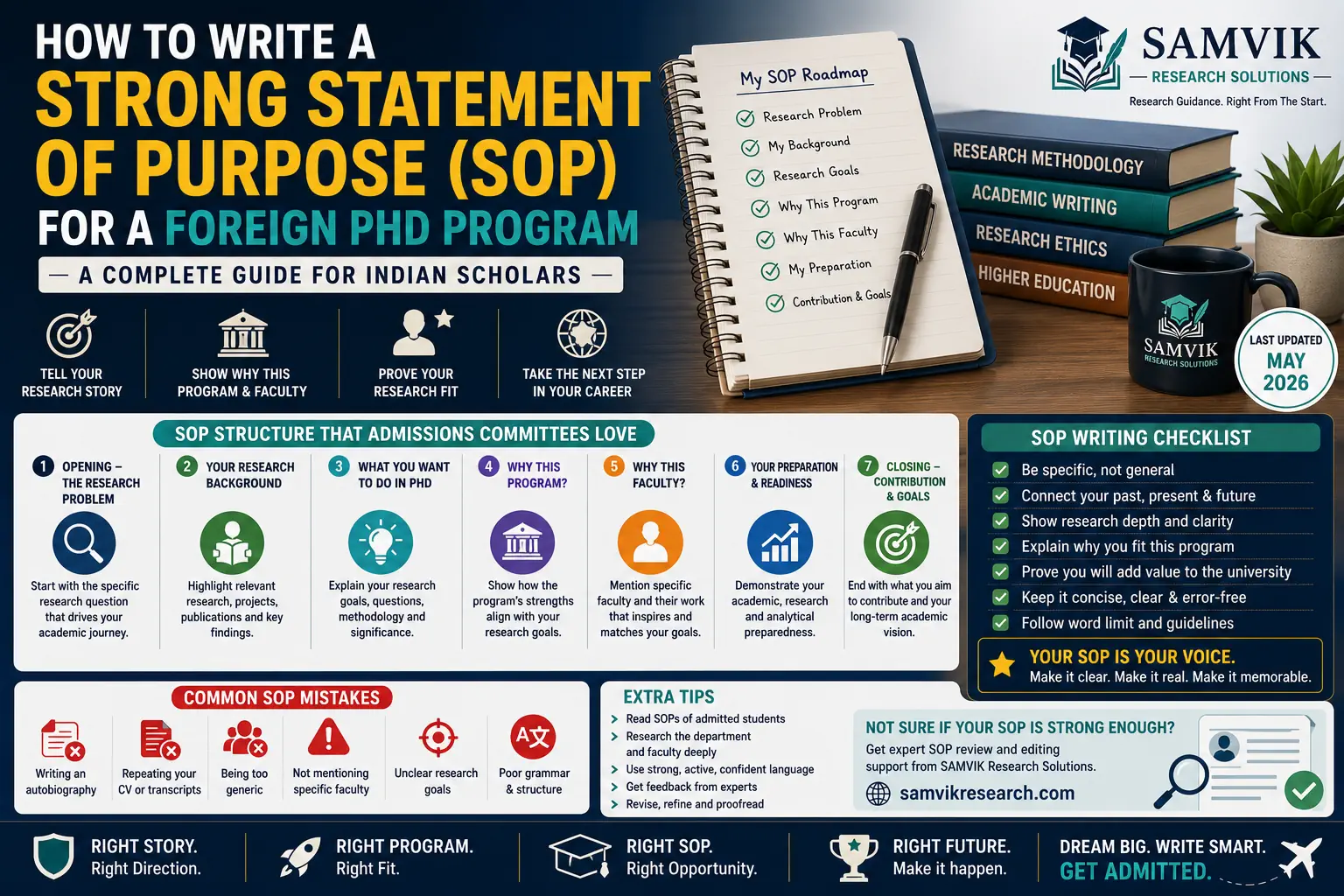
500–1500Words in a strong PhD SOP3Sentences that decide if the reader continues4Questions every SOP must answer in sequence#1Most important document in a foreign application
A statement of purpose for PhD admission abroad is a personal academic essay explaining your research interests, academic background, future goals, and why you are applying to a specific university and specific faculty member. It is the most important document in your foreign PhD application — and the one most Indian scholars get wrong.
Your transcripts show what you studied. Your recommendation letters show what others think of you. The SOP is the only place where you speak directly and make the case for why you belong in that programme. Most applicants waste this opportunity by writing an autobiography instead of a research argument. This guide shows you exactly what to do instead.
What Is a Statement of Purpose for PhD Abroad?
An SOP for a foreign PhD programme is a 500 to 1,500 word academic essay addressed directly to an admissions committee. Its job is to answer four questions in sequence: what research problem are you working on, what have you already done toward it, what do you want to do next, and why is this specific programme the right place to do it.
It is not a CV in prose. It is not a career story. It is not a general expression of passion for the field. It is a focused, specific argument for why you and this programme are the right match at this moment.SOP Format for PhD Applications Abroad
A strong SOP moves through five sections, each doing one job. Together they build a single argument — that you have a real research direction and this programme is where it should continue.
SECTION 01Research problem and hook
Introduce the specific intellectual question driving your research. Not your life story. Not your passion for the field. The question itself.
SECTION 02Your research background
What have you already done toward this question — thesis, publications, fieldwork, lab work, independent research? What did you find, and what did that reveal about what still needs to be understood?
SECTION 03What you want to do in the PhD
Your proposed research direction, even if tentative. Specific enough that a relevant faculty member could see themselves supervising it.
SECTION 04Faculty and programme fit
Name specific faculty members whose work connects to yours. Explain what their research contributes and what you want to explore with them. This is where most Indian applications fail.
SECTION 05Closing and contribution
What you will bring to the programme, the field, and where this research goes after the degree.
How to Start an SOP for PhD Applications
The opening of your SOP determines whether the reader continues. Most application readers make that decision in the first three sentences.
⚠️ Do not begin with your childhood. Do not begin with "Since I was young, I have been passionate about science." Do not begin with a broad statement about the importance of your field. These openings signal a generic, autobiography-style SOP — and readers have seen thousands of them.Begin with the research problem. The strongest SOP openings place the reader immediately inside a specific intellectual question. For example:
"How do first-generation college students in rural India navigate academic identity when their family's entire frame of reference for higher education is absent? This question has shaped every research decision I have made in the last three years."That opening tells the committee what you think about, why it matters, and that you have been working on it seriously. It is specific, it is original, and it compels the reader to keep going.
Sample SOP Structure for Foreign Universities
A strong PhD SOP opening paragraph introduces the research problem in two to three sentences, establishes why it matters in one sentence, and signals that the applicant has already been working on it.
The research background section names the specific project — Masters thesis, publication, independent research — summarises the key finding in one to two sentences, and explains what that finding revealed about the unresolved gap the PhD will address.
The research direction section identifies the proposed PhD question or direction, indicates the methodological approach, and explains why this question is significant to the field now.
The faculty fit section names one to two specific faculty members, explains what their published research contributes to the problem, and identifies the specific aspect of that work the applicant wants to build on or extend.
The closing states the contribution the applicant will make to the programme and where the research goes after the degree — in two to three direct sentences.
Common SOP Mistakes Indian Students Make
MISTAKE 01Writing about the journey instead of the research
✅ Fix: Committees want to see what you think, not what happened to you. Lead with the intellectual question, not your biography.MISTAKE 02Being vague about the research direction
✅ Fix: "I am interested in environmental policy" is a topic. "I want to examine whether judicial mandates without implementation mechanisms change state-level forest administrative behaviour in Central India" is a research direction.MISTAKE 03Sending the same SOP to every programme
✅ Fix: The faculty fit section must be rewritten for every application. A generic SOP is identifiable within one paragraph and almost never results in shortlisting.MISTAKE 04Not naming specific faculty
✅ Fix: Writing "your programme has strong faculty in my area" tells the committee nothing and signals you did not engage with their actual research community. Name one to two specific researchers and their work.MISTAKE 05Using complex vocabulary to appear sophisticated
✅ Fix: Clear, direct sentences communicate intelligence better than convoluted ones. Read your SOP aloud — if a sentence is difficult to say, it is difficult to read.MISTAKE 06Mentioning every academic achievement
✅ Fix: Everything in the SOP should connect back to your research direction. If an experience does not strengthen that argument, leave it out.Why SOPs Get Rejected by Foreign Universities
The most common rejection reason is a mismatch between what the applicant claims to want and what the programme actually offers. If your stated research direction has no faculty match in the department you are applying to, the SOP cannot succeed regardless of how well it is written.
The second most common reason is insufficient research specificity. Foreign PhD programmes — particularly in North America, Europe, and Australia — expect applicants to demonstrate that they have a genuine research direction, not just an interest in a broad subject.
The third is a failure to demonstrate English language proficiency beyond a test score. A poorly written SOP signals to committees that the applicant will struggle with the writing demands of a doctoral programme — regardless of IELTS or TOEFL scores.
SOP for Scholarships — Fulbright, DAAD, Commonwealth, MEXT
Scholarship SOPs have different requirements from programme SOPs and must be treated separately. In every case, read the funding body's mission statement and ensure your SOP directly addresses their specific priorities — not just your research interests.
| Scholarship | Country | What the SOP must additionally prove |
|---|---|---|
| Fulbright | USA | How your research contributes to mutual understanding between India and the United States. Research merit alone is not sufficient — connect your work to the programme's exchange goals. |
| DAAD | Germany | Why Germany specifically, and why this particular German institution. Reviewers look for genuine intellectual connection to German research traditions, not just prestige. |
| Commonwealth | UK | A strong development impact argument — how will your research benefit India or the broader developing world? Assessed separately from academic merit. |
| MEXT | Japan | Both a research plan and a study plan, typically submitted separately. The research plan must name a specific Japanese supervisor who has informally agreed to receive you. |
Country-Specific SOP Differences
| Country | Length | Emphasis |
|---|---|---|
| United States | 1,000–1,500 words | Fit with research culture, faculty alignment, and contribution to the department's intellectual community. Expects considerable research specificity. |
| United Kingdom | 500–800 words | Functions as a research pitch more than a personal statement. Wants a clear, feasible research question and evidence of independent research capability. Supervisor relationship usually established before applying. |
| Germany | Separate exposé 3,000–5,000 words + shorter motivational letter | Formal and methodologically specific. |
| Canada & Australia | 800–1,500 words | Similar to the US model, with strong emphasis on faculty fit and research direction. |
Can You Use AI to Write Your SOP?
This is one of the most searched questions among Indian scholars applying abroad in 2026 — and the answer matters. AI tools can help you structure your thinking, identify gaps in your argument, and improve grammatical clarity. Using AI for these purposes is acceptable and increasingly common.
What AI cannot do is write a genuinely compelling SOP for you. Admissions committees read hundreds of SOPs every cycle. AI-generated language has recognisable patterns — a certain smoothness, a certain generality, a tendency to stay safe rather than specific. An AI-written SOP will sound polished and say nothing. The specificity, the particular research observation, the honest account of a finding and what it revealed — these are things only you can write because only you know your research.
Use AI to improve what you have written. Do not use it to write what you should say. The difference in outcome is significant.Frequently Asked Questions: SOP for Foreign PhD Applications
What is the difference between an SOP and a research proposal?▾A research proposal is a detailed technical document of 2,000 to 5,000 words presenting your methodology, literature review, and expected contribution in formal academic structure. An SOP is a 500 to 1,500 word persuasive narrative addressed to an admissions committee. Indian scholars often confuse the two because they have experience writing proposals but not Western-style personal statements. They require completely different approaches.How specific should my research direction be in the SOP?▾Specific enough that a faculty member in your area reads it and thinks: this person could work with me. You do not need a complete dissertation plan. You need to name your research question, indicate the methodological direction, and explain why the question matters now. Vague expressions of interest in a broad area will not shortlist you at competitive programmes.Should I mention my UGC or CSIR fellowship in my SOP?▾Yes. These are competitive national fellowships that signal research quality to foreign committees who may not be familiar with the Indian system. Briefly explain what the fellowship is and why it is selective — never assume the committee knows.Can I use the same SOP for multiple applications?▾The core narrative of your research background can remain consistent. But the faculty fit section must be rewritten completely for every application. A generic SOP is identifiable immediately and rarely results in admission to competitive programmes.How is an SOP for a scholarship different from one for a PhD programme?▾Scholarship SOPs require you to address the funding body's specific priorities — exchange goals, development impact, or country-specific research collaboration — in addition to your academic merit and research direction. A strong academic SOP may not be a strong scholarship SOP if it does not speak to what the funding organisation is trying to achieve.MDr. Mukul MisraSenior Academician, Researcher & Research AdministratorDr. Mukul Misra holds a PhD in Electronic Sciences and has over two decades of academic and research leadership across India, Japan, and the United Kingdom — including a JSPS Fellowship at Osaka University and research roles at the universities of Warwick and Bath. At SAMVIK Research Solutions he guides Indian scholars on foreign PhD applications, faculty-fit framing, and fellowship strategy (ANRF, Fulbright, DAAD, MEXT).Is Your SOP Strong Enough for Foreign PhD Admissions?
Get your SOP reviewed before submission. SAMVIK Research Solutions works with Indian scholars on SOP drafting and review — helping researchers articulate their research direction clearly and compellingly in academic English without losing their own voice. The SAMVIK team reviews your research argument, faculty-fit framing, and opening hook, and gives specific feedback on what is working and what is not before you submit.
Get Your SOP Reviewed by SAMVIK →Related reading: How to Write a Research Proposal That Gets Approved · ANRF Fellowship and Research Funding India 2026 · Scopus vs WoS vs UGC CARE · How to Avoid Desk Rejection