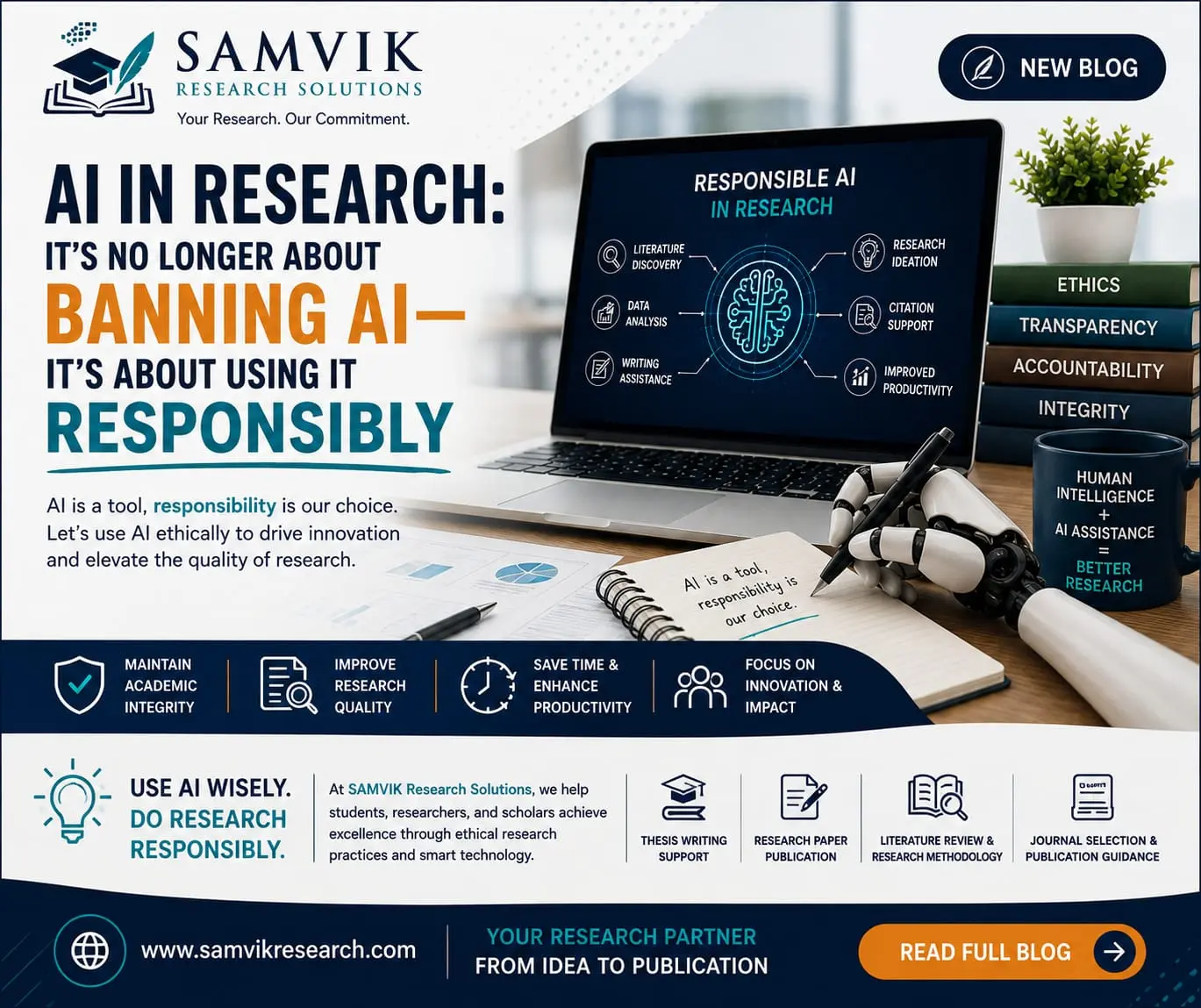

Three years ago, the conversation around artificial intelligence in academia was dominated by a single word: ban. Institutions scrambled to block ChatGPT on campus networks, rewrote plagiarism policies overnight, and treated every AI-assisted paragraph as academic dishonesty in waiting. That era is effectively over — not because the concerns disappeared, but because the numbers made prohibition impossible to sustain.
A 2026 global survey of over 45,000 students and faculty across 35 countries found that 88 percent of students now use AI in their learning, and 77 percent of faculty use it in their teaching — up 16 percentage points from just a year earlier. Separate research puts overall student AI usage even higher, noting that global student AI adoption climbed from 66 percent in 2024 to 92 percent in 2025. Whichever figure you trust, the direction is unmistakable: AI is no longer an edge case in research and academic writing. It is the default.
At SAMVIK Research Solutions, this is the exact gap we help scholars, institutions, and researchers close. This article breaks down what responsible AI use in research actually looks like — grounded in current data, practical frameworks, and the realities of academic publishing today.
The Shift: From Prohibition to Policy
Banning AI in research was never a sustainable strategy — it was a stalling tactic. Here’s why the shift toward responsible-use policy has become inevitable:
| Old Approach (2022–2024) | Emerging Approach (2025–2026) |
|---|---|
| Block AI tools on campus networks | Teach AI literacy as a core academic skill |
| Treat all AI use as misconduct | Define disclosure standards for AI-assisted work |
| Detect and punish after the fact | Design assessments that are AI-resilient by nature |
| One-size-fits-all policy | Discipline-specific and task-specific guidelines |
| Faculty left to self-police | Institution-wide training and governance frameworks |
This shift isn’t just philosophical — it’s backed by outcomes. Faculty are also grappling with their own adoption curve. In North America specifically, faculty intent to keep using AI in teaching actually declined by 9 percentage points between 2025 and 2026, from 76 percent down to 67 percent — the lowest regional adoption intent globally, largely tied to unresolved concerns about integrity, workload, and institutional support.
Institutions investing heavily in AI-detection software are fighting a losing battle — detection tools have well-documented accuracy problems and can’t keep pace with newer models. The more durable strategy is disclosure-based policy: requiring researchers and students to explicitly state how and where AI was used (drafting, editing, literature search, code, translation) rather than trying to prove it was used at all. Journals like Nature, Science, and most Scopus-indexed publishers have already moved to this model. SAMVIK builds this disclosure-first approach into every research deliverable we support.
Where AI Genuinely Helps Research (When Used Responsibly)
Responsible AI use isn’t about minimizing AI — it’s about deploying it in the right places in the research pipeline.
1. Literature discovery and synthesis
AI tools can rapidly surface relevant papers, summarize abstracts, and identify research gaps — provided the researcher independently verifies every citation against the original source. This is precisely why SAMVIK’s own review pipelines pair AI-assisted discovery with manual verification of every reference before it reaches a client.
2. Language refinement for non-native English speakers
For the majority of global researchers who write in a second or third language, AI-assisted editing for grammar, clarity, and tone represents one of the most defensible and widely accepted uses of AI in academic writing — most journals explicitly permit this.
3. Data analysis and visualization support
AI can accelerate statistical scripting, formatting of forest plots, and exploratory data analysis, freeing researchers to focus on interpretation rather than mechanical output generation.
4. Structuring and formatting
Reference formatting (Vancouver, APA, IEEE), PRISMA flow construction, and manuscript formatting are low-risk, high-value AI applications, since the underlying scientific content still originates from the researcher.
5. Idea generation and proposal drafting
Brainstorming research questions, hypotheses, or methodology options with AI can sharpen a proposal — as long as originality and feasibility are independently validated by the researcher and their advisor.
Where AI Use Becomes Risky or Irresponsible
| Responsible Use ✅ | Irresponsible Use ❌ |
|---|---|
| Using AI to summarize literature you’ve read | Generating citations to papers you haven’t verified exist |
| AI-assisted grammar and clarity editing | Letting AI write entire results/discussion sections unedited |
| Brainstorming methodology options | Fabricating data or statistical outputs |
| Disclosing AI use per journal/institution policy | Concealing AI involvement in submitted work |
| Using AI to explain a statistical concept | Submitting AI-generated analysis without understanding it |
Myth vs. Fact: Common Misconceptions About AI in Research
Myth: “If I use AI at all, my work is automatically considered academic misconduct.”
Myth: “AI detection tools can reliably prove AI was used.”
Myth: “Using AI means I don’t need to check citations myself.”
Myth: “Faculty and students are on the same page about acceptable AI use.”
Myth: “Only students use AI — faculty and researchers don’t.”
Timeline: The Rapid Rise of AI in Academic Research
| Year | Milestone |
|---|---|
| 2022 | ChatGPT launches; universities begin ad hoc bans and panic-driven policy |
| 2023 | Detection tools (Turnitin AI, GPTZero) adopted widely; first major hallucinated-citation scandals surface in academic publishing |
| 2024 | Global student AI usage reaches roughly 66 percent; journals begin issuing formal AI-disclosure guidelines |
| 2025 | Adoption crosses 86–92 percent among students globally; institutions shift from bans toward AI-literacy curricula |
| 2026 | 88 percent of students and 77 percent of faculty report active AI use; governance and training remain the primary unresolved gap |
Building a Responsible AI Research Workflow: A Practical Framework
For researchers, scholars, and institutions looking to formalize responsible AI use, a defensible workflow generally includes:
The 5-Step Responsible AI Framework
- Define the boundary — Decide explicitly what AI may assist with (language, formatting, brainstorming) versus what must remain fully human-authored (original analysis, conclusions, novel claims).
- Disclose transparently — State AI involvement in a methods note or acknowledgments section, matching your target journal’s specific policy.
- Verify everything — Treat every AI-generated fact, statistic, or citation as unverified until checked against a primary source.
- Preserve intellectual ownership — Ensure the core argument, interpretation, and conclusions originate from the researcher, not the model.
- Document your process — Keep records of prompts and AI outputs used, particularly for funded research or work headed toward peer review.
Frequently Asked Questions
Yes, when used for tasks like language editing, literature summarization, or brainstorming — and disclosed according to your institution’s or journal’s policy. It becomes unethical when AI is used to fabricate data, generate fake citations, or produce unedited content presented as fully original work.
Not inherently. Plagiarism concerns proper attribution of ideas, not tool usage. However, submitting AI-generated text without disclosure, when disclosure is required, can constitute academic misconduct under many current policies.
No. AI models can generate citations to papers that don’t exist or misattribute real findings. Every AI-suggested citation must be manually verified against the original published source before use.
Increasingly, yes. Most institutions have moved from outright bans toward disclosure-based frameworks that permit AI for specific tasks while requiring transparency about its use.
SAMVIK combines AI-powered research tools with human expert verification — every citation, statistic, and claim in a SAMVIK-supported deliverable is checked against real, published literature, ensuring the speed of AI with the rigor academia demands.
Conclusion: Responsible AI Is the New Research Literacy
The debate has moved on. It is no longer “should researchers use AI” — the adoption data has already answered that question definitively. The real question institutions, scholars, and research support organizations must now answer is how AI gets used: transparently, verifiably, and in service of better research rather than shortcuts around it.
At SAMVIK Research Solutions, this is the principle behind everything we build — from AI-assisted literature reviews with fully verified citations, to systematic reviews with reproducible meta-analyses, to proposal development for PhD scholars targeting top institutions. We don’t treat AI as a shortcut or a threat. We treat it as a tool that, used responsibly, raises the ceiling of what rigorous research can achieve.
Ready to build research that’s fast, credible, and responsibly AI-assisted?
Explore SAMVIK’s research support services — from literature reviews to full publication support.
Explore SAMVIK's Research Support →